ACE-083 1 mg vial
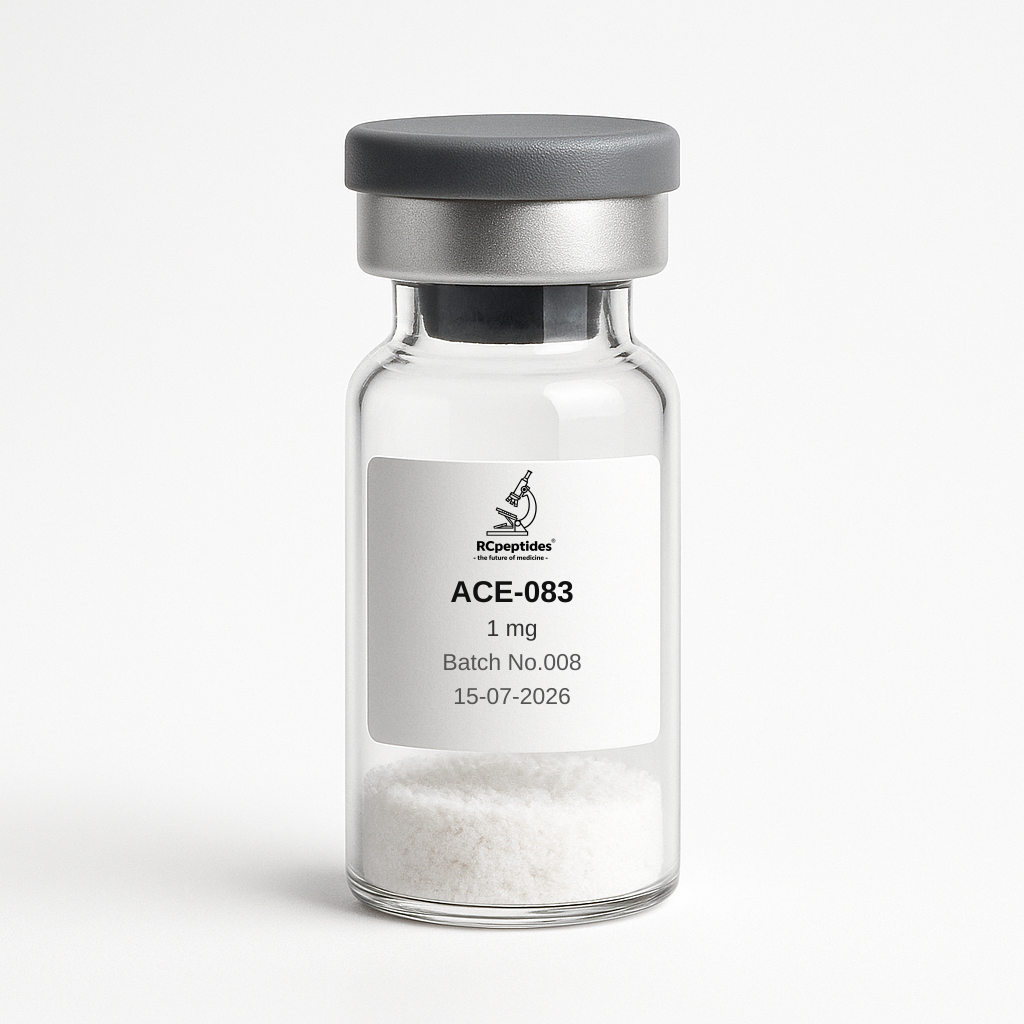
ACE-083 1 mg vial — ACE-083 is an investigational follistatin-based fusion protein developed to bind myostatin and related muscle-regulating ligands. Its clinical programme examined local muscle effects. It is different from ACE-031, which uses an activin receptor type IIB construct, and should not be described as the same protein.
1. Compound and product overview
| Detail | Description |
|---|---|
| Compound | ACE-083 |
| Class / target | Follistatin-based fusion protein; local ligand-trap research |
| Labelled presentation | ACE-083 1 mg vial |
| Research focus | Muscle volume, muscle composition and functional outcome assessment |
2. Mechanism and biological rationale
The research rationale was to reduce inhibitory signalling from selected ligands near the investigated muscle. The clinical studies used local intramuscular administration of a defined investigational formulation. That trial characteristic does not establish a route or preparation method for this research vial.
The important distinction is between muscle size and useful function. An imaging-based increase in total muscle volume can occur without a corresponding improvement in strength, walking or patient-reported outcomes. It is therefore inaccurate to describe an increase in volume as proof of improved physical function.
3. Benefits and effects studied
The table describes endpoints investigated in the cited research. The evidence level and study setting matter: findings for a study compound or pharmaceutical formulation do not establish the same outcomes for this catalogue material.
| Research area | Findings and evidence limits |
|---|---|
| Local muscle volume | A randomized phase 2 study in facioscapulohumeral muscular dystrophy reported increased total muscle volume with ACE-083 compared with placebo. This was a defined imaging endpoint. |
| Functional outcomes | The same study did not show consistent improvement in functional or patient-reported outcomes despite the volume changes. The negative findings are essential to interpreting the programme. |
| Muscle composition | The trial assessed muscle-composition measures alongside other outcomes. These help distinguish different aspects of a response, but should not be collapsed into a claim of restored muscle health. |
| Research value | The results illustrate why ligand-trap studies need both structural and functional endpoints. They do not establish ACE-083 as an effective treatment for muscular dystrophy, ALS or age-related weakness. |
4. Evidence in context
The published phase 2 trial provides a useful example of a biological effect that did not translate into consistent functional benefit. Descriptions that promise improved mobility or delayed disease progression overstate the findings. The trial should be evaluated on its prespecified endpoints and population.
For laboratory evaluation, distinguish follistatin-based constructs from receptor-based traps and from antibodies directed at a single ligand. Binding specificity, protein integrity and functional activity cannot be inferred solely from the labelled mass. This 1mg presentation is a catalogue specification, not a medicinal formulation.
5. Product identity and laboratory considerations
Match the product name and labelled amount to the batch documentation before selecting a material for an experiment. Identity, purity and measured content answer different questions: a purity percentage alone does not establish the amount of the named compound, its biological activity, or the absence of every possible contaminant.
Use the original certificate where available to check the tested batch, analytical method and reported results. A result belongs to the sample and tests described in that report; it should not be extended to a different batch or treated as a clinical evaluation. Storage, solvent compatibility and stability after preparation require the documentation for the actual material and the conditions of the planned assay. A vial size is a product specification, not a treatment schedule.
6. Research scope
This listing supplies a research material. Published clinical studies use defined formulations, eligibility criteria, monitoring and analytical controls that are not established by this product listing. Laboratory observations, biomarkers and clinical outcomes should be interpreted separately. The cited literature provides background for scientific evaluation; it is not evidence that this particular product has been tested for therapeutic efficacy or safety.
Selected scientific references
For in vitro laboratory research use only. Not for human or veterinary use. Not intended for diagnosis, treatment or prevention of disease.
Price: €180.00
Collection: Myostatin Inhibitors
Research use only. Not for human consumption.