Adipotide 5mg vial
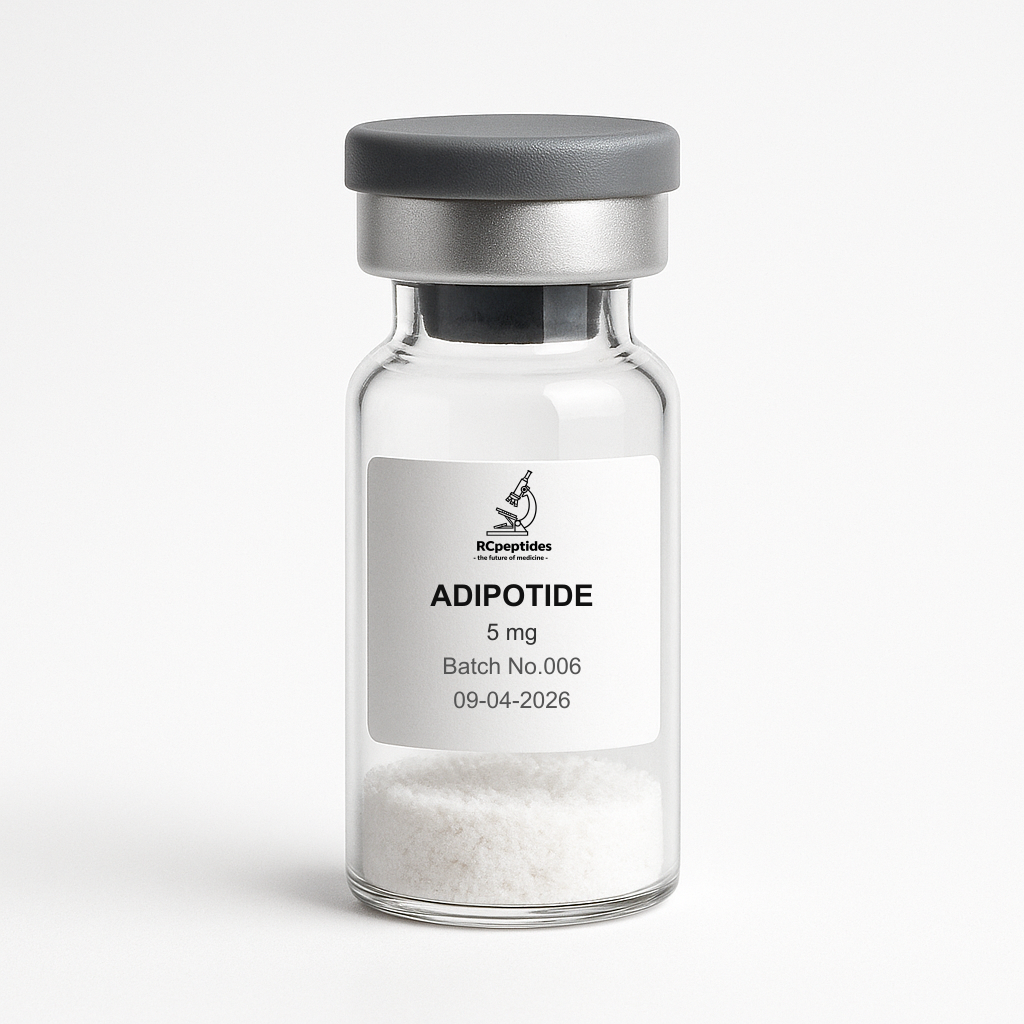
NOT FOR HUMAN CONSUMPTION
Adipotide is an investigational fat-targeted proapoptotic peptidomimetic designed to ablate white-adipose vasculature
Adipotide (also called FTPP or Prohibitin-TP01) is an investigational peptidomimetic built from a white-fat vascular homing motif linked to a proapoptotic mitochondrial-disrupting domain. Its core idea is unusual: instead of suppressing appetite through CNS pathways or mimicking gut hormones, adipotide is designed to bind endothelial cells in white adipose tissue, trigger apoptosis in the supporting vasculature, and thereby shrink fat mass. The best-known efficacy data are preclinical, especially in rodents and obese Old World monkeys. It is not FDA- or EMA-approved.
Additional Benefits of Adipotide Under Investigation
| BENEFIT | KEY TAKE-AWAYS |
|---|---|
| 1 Rapid fat-mass reduction | In obese Old World monkeys, adipotide produced rapid weight loss attributable to a marked reduction in white adipose tissue, confirmed by MRI and DEXA. |
| 2 Visceral-fat targeting | Imaging in rhesus monkeys suggested the weight loss occurred primarily because of visceral fat loss, which is metabolically relevant. |
| 3 Insulin-resistance improvement | In the monkey study, treatment was associated with improved insulin resistance, including a large fall in insulin AUC in treated animals and a lower insulinogenic index in the fixed-dose study. |
| 4 Rodent obesity reversal signals | Earlier mouse and rat studies showed major body-fat and body-weight reductions in diet-induced and genetic obesity models. |
| 5 Appetite reduction secondary to adipose targeting | In mice and rats, the peptide reduced food intake after treatment began, with data arguing against a direct CNS toxic effect or nonspecific illness as the main driver. |
| 6 Non-GI mechanism | Unlike lipase inhibitors, adipotide was not developed to block fat absorption; the primate paper noted the observed pattern was inconsistent with increased fecal fat elimination as the mechanism. |
| 7 Human translational rationale | The adipotide program was built partly on reports of a human white-adipose vascular annexin A2–prohibitin receptor system, which provided some translational justification for clinical development. |
| 8 Distinct from incretin drugs | Its therapeutic concept is vascular targeting and adipose ablation, not GLP-1/GIP appetite signaling, making it mechanistically very different from current obesity drugs. |
| 9 Major renal-liability signal | The main repeatedly discussed safety issue in primates was predictable, reversible renal proximal-tubule dysfunction/injury, which is a major translational limitation. |
2. Molecular Mechanism of Action
2.1 Receptor / Target Pharmacodynamics
Adipotide uses a cyclic homing motif, CKGGRAKDC, identified by in-vivo phage display, to target prohibitin on endothelial cells in the vasculature of white adipose tissue. That homing segment is fused to D(KLAKLAK)2, an amphipathic proapoptotic peptidomimetic that disrupts mitochondrial membranes after receptor-mediated internalization. The combined construct is intended to selectively induce apoptosis in fat-associated vascular endothelium.
2.2 Down-stream Biology
| PATHWAY | Details |
|---|---|
| Prohibitin-directed vascular homing | FUNCTIONAL OUTCOME: Preferential delivery to white-fat endothelium CONTEXT: Rodent and primate adipose-targeting concept |
| Mitochondrial membrane disruption via D(KLAKLAK)2 | FUNCTIONAL OUTCOME: Endothelial apoptosis CONTEXT: Core proapoptotic payload mechanism |
| Adipose-vascular regression | FUNCTIONAL OUTCOME: Reduction in white adipose mass CONTEXT: Observed in rodents and obese monkeys |
| Secondary hypophagia | FUNCTIONAL OUTCOME: Reduced food intake after adipose targeting CONTEXT: Seen in obese mice and rats; not explained by direct hypothalamic injury in that study |
| Metabolic improvement | FUNCTIONAL OUTCOME: Lower insulin resistance, lower free-fatty-acid trend CONTEXT: Preclinical primate data |
3. Pharmacokinetics
Route:
Published efficacy studies used parenteral administration, typically subcutaneous injection in rodent studies, and the first-in-human program was described as a single 28-day cycle in patients with advanced prostate cancer and obesity.
Absorption / half-life:
I did not find a robust peer-reviewed human pharmacokinetic paper for adipotide. Public trial descriptions mention that Phase 1 intended to assess PK, but I did not find published human PK results.
Distribution / clearance:
The primate paper’s renal findings suggest that cleared adipotide or its handling in the proximal tubule may be relevant to toxicity, and the authors explicitly discuss possible competitive effects on tubular creatinine secretion. That makes renal handling a central translational issue.
Formulation practicality:
Unlike once-weekly obesity drugs, adipotide’s public preclinical/clinical-development framing was not built around long half-life endocrine signaling; it was a targeted cytotoxic peptide strategy, which likely contributed to a very different tolerability and development profile.
4. Pre-clinical and Clinical Evidence
4.1 Rodent obesity models
Earlier mouse and rat studies reported that the proapoptotic peptide reduced body weight and fat mass in ob/ob mice, diet-induced obese mice, and obese rats. In one mouse protocol, animals receiving daily subcutaneous peptide treatment over 27 days showed marked body-weight reduction, and the paper concluded that the reduction was primarily body fat and occurred with decreased food intake rather than increased energy expenditure.
4.2 Obese nonhuman primates
The best-known translational study is the 2011 Science Translational Medicine report in obese Old World monkeys. The authors reported rapid weight loss, imaging-confirmed reduction in white adipose tissue, predominant visceral fat loss, and improved insulin resistance. In treated monkeys, insulin AUC fell by more than 60% in two animals in one part of the study, and the fixed-dose study showed a substantial drop in the average insulinogenic index.
4.3 Human evidence
A public ClinicalTrials.gov entry and company press releases show that a first-in-human Phase 1 program was initiated to identify the highest tolerable dose of PROHIBITIN-TP01 / adipotide in patients with advanced prostate cancer and obesity, with PK and weight-related measures among the planned assessments. However, I did not find peer-reviewed human efficacy or safety results from that program.
Evidence quality note:
Adipotide has much stronger preclinical than clinical support. The headline metabolic effects come from animal studies, especially the monkey study, while human translation remains limited and publicly incomplete.
5. Emerging Clinical Interests
| FIELD | Details |
|---|---|
| Obesity with high visceral fat burden | RATIONALE: Direct fat-vasculature ablation concept STATUS: Preclinical, no approved use |
| Obesity-linked insulin resistance | RATIONALE: Monkey data showed improved insulin resistance alongside fat loss STATUS: Preclinical translational signal |
| Obesity in prostate-cancer setting | RATIONALE: First human study was framed around advanced prostate cancer plus obesity STATUS: Early clinical exploration only |
| Adipose-vascular targeting as a platform | RATIONALE: Supports broader research into depot-selective adipose therapeutics STATUS: Conceptual / platform-stage |
6. Safety and Tolerability
Main preclinical liability:
The most important safety signal in primates was renal proximal-tubule dysfunction/injury. The monkey paper describes these renal changes as predictable and reversible at experimentally determined optimal doses, but they were still the primary adverse effect and a major barrier to straightforward obesity-drug development.
GI tolerability / mechanism-related adverse effects:
Adipotide was not developed as a gut-acting appetite suppressant or fat-absorption blocker, and the available preclinical discussion does not center on the classic GLP-1-like nausea profile or orlistat-like steatorrhea profile. Instead, its main concern is targeted cytotoxicity with renal handling concerns.
Human safety profile:
There is no established human safety profile in the literature I could verify. The public Phase 1 trial listing and press materials show the program entered human testing, but I did not find a peer-reviewed publication establishing a tolerated dose, reproducible efficacy, or longer-term safety profile.
Comparative safety / translational matrix
| FEATURE | Details |
|---|---|
| Core mechanism | ADIPOTIDE: Fat-vasculature targeting and endothelial apoptosis GLP-1 / GIP-BASED OBESITY AGENTS: Appetite and metabolic hormone signaling |
| Main efficacy evidence | ADIPOTIDE: Rodents + obese monkey study GLP-1 / GIP-BASED OBESITY AGENTS: Large human RCTs |
| Key adverse-effect concern | ADIPOTIDE: Renal proximal-tubule injury/dysfunction signal in primates GLP-1 / GIP-BASED OBESITY AGENTS: Mostly GI adverse effects, class-specific warnings |
| Human dose-finding evidence | ADIPOTIDE: Very limited public evidence GLP-1 / GIP-BASED OBESITY AGENTS: Extensive |
| Regulatory status | ADIPOTIDE: Investigational only GLP-1 / GIP-BASED OBESITY AGENTS: Several approved drugs exist |
This is why adipotide is scientifically interesting but much less clinically mature than modern incretin-based obesity therapies.
7. Regulatory Landscape
Approval status:
Adipotide is investigational and has no marketing authorization that I could verify from FDA/EMA-facing public sources. Arrowhead announced FDA clearance in 2012 to initiate a Phase 1 study, but that is not the same as approval.
Programs:
Public records show a first-in-human program in the obesity/prostate-cancer setting, but I did not find evidence of later-stage development, approved labeling, or published pivotal human trials.
Use outside research:
Because human evidence is sparse and the main preclinical safety issue was renal toxicity, adipotide is best understood as a research-stage compound, not a clinically established weight-loss therapy.
8. Future Directions
-
A safer adipose-targeting vascular approach would likely need a better therapeutic index than the original adipotide construct.
-
Any revival of the concept would need clear human PK, kidney-safety mitigation, and modern dose-ranging studies.
-
The most durable scientific contribution of adipotide may be as a proof of concept that adipose mass can be manipulated through its vasculature, rather than as a near-term commercial obesity medicine.
Selected References
-
Barnhart KF, et al. A Peptidomimetic Targeting White Fat Causes Weight Loss and Improved Insulin Resistance in Obese Monkeys. Science Translational Medicine (2011). Core primate paper: rapid weight loss, visceral-fat reduction, insulin-resistance improvement, renal signal.
-
Kim DH, et al. Peptide Designed to Elicit Apoptosis in Adipose Tissue Endothelium Reduces Food Intake and Body Weight. Diabetes (2010). Rodent work on weight loss, fat loss, and secondary hypophagia.
-
ClinicalTrials.gov / NCT01262664. First-in-human Phase 1 listing for PROHIBITIN-TP01 in advanced prostate cancer and obesity.
-
Arrowhead press releases (2012). FDA IND clearance and first-patient-dosed announcements for adipotide. Useful for public development history, but not substitutes for peer-reviewed human results.
For in vitro laboratory research use only. Not for human or veterinary use. Not intended for diagnosis, treatment or prevention of disease.
Price: €60.00
Collection: GLP
Batch test results and COAs
Research use only. Not for human consumption.