BPC-157 10mg vial
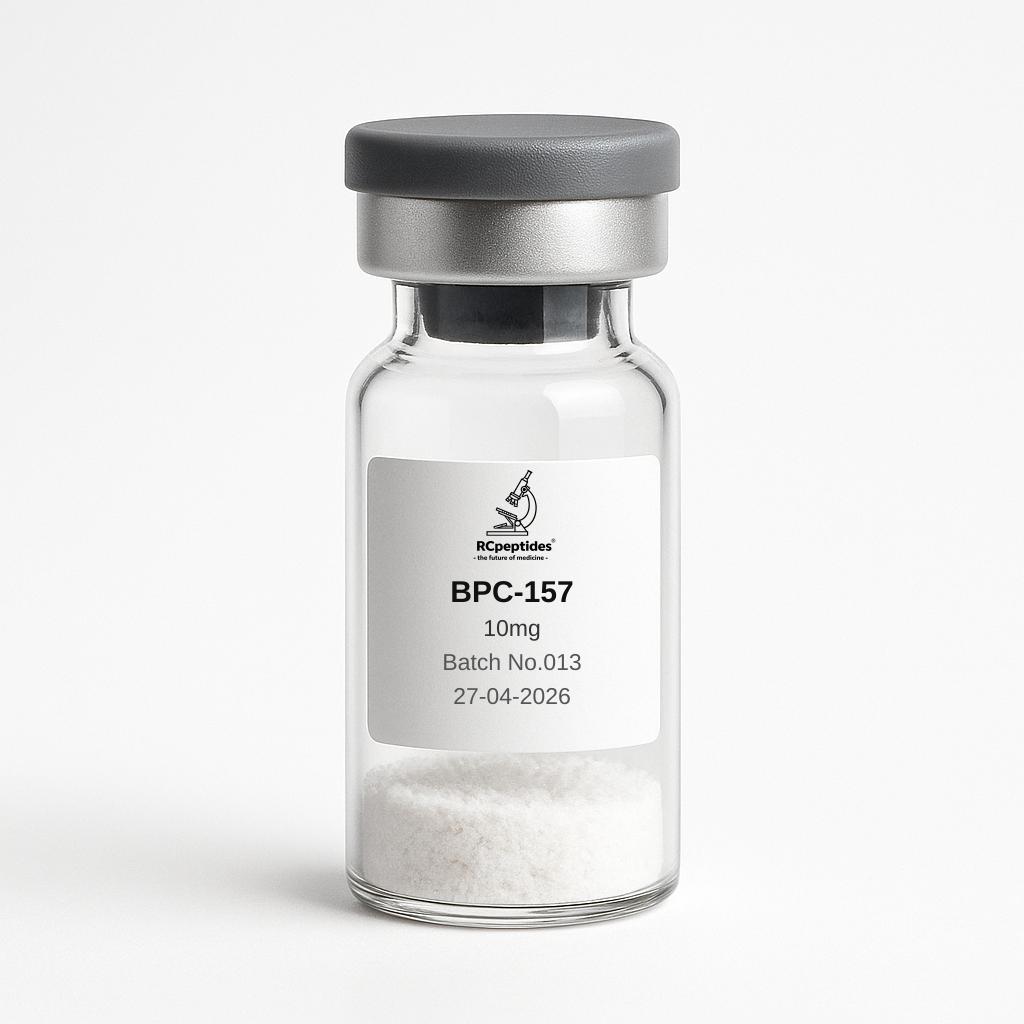
BPC-157 10mg vial — BPC-157 is a synthetic peptide consisting of 15 amino acids, investigated in experimental tissue-response and injury models. Its research literature includes cell-culture, tissue-explant and animal work. These findings should be distinguished from established clinical treatments for tendon, gastrointestinal or other disorders.
1. Compound and product overview
| Detail | Description |
|---|---|
| Compound | BPC-157 (Body Protection Compound 157) |
| Class / target | Synthetic pentadecapeptide; tissue-response signalling investigated preclinically |
| Labelled presentation | BPC-157 10mg vial |
| Research focus | Tendon fibroblasts, cell migration and experimental tissue-repair biology |
2. Mechanism and biological rationale
Rather than assigning every reported effect to one proven human receptor, the literature examines multiple signalling responses. A tendon study measured cell migration and changes in focal adhesion kinase and paxillin phosphorylation. These proteins are involved in cellular adhesion and movement; a change in their signalling does not by itself prove repair of a human injury.
Another primary study examined growth hormone receptor expression in tendon fibroblasts. This was a cellular observation and should not be rewritten as evidence that BPC-157 increases circulating growth hormone or reliably improves muscle growth. Mechanism, tissue response and clinical function remain separate levels of evidence.
3. Benefits and effects studied
The table describes endpoints investigated in the cited research. The evidence level and study setting matter: findings for a study compound or pharmaceutical formulation do not establish the same outcomes for this catalogue material.
| Research area | Findings and evidence limits |
|---|---|
| Tendon-explant outgrowth | A 2011 study reported greater outgrowth in rat tendon explants and enhanced fibroblast migration under the tested conditions. This is preclinical evidence rather than a randomized human tendon-healing result. |
| Stress-related cell survival | The same work found improved survival under an oxidative-stress condition. It did not directly increase proliferation of the cultured tendon fibroblasts in the reported assay, an important distinction from a blanket cell-growth claim. |
| Signalling pathways | FAK and paxillin phosphorylation were examined as possible contributors to migration. These findings identify research pathways, not a complete or uniquely established mechanism for every claimed effect. |
| Growth hormone receptor expression | A separate tendon-fibroblast study reported increased receptor expression. This supports a specific laboratory question and does not establish clinical efficacy or a systemic hormone effect. |
4. Evidence in context
Animal tissue, isolated cells and human clinical outcomes are different settings. A favourable preclinical result does not establish the speed of recovery, a treatment success rate or the safety of repeated exposure in people. Claims of guaranteed tendon repair, cure of inflammatory bowel disease or general organ protection go beyond the studies summarized here.
The catalogue includes different labelled BPC-157 presentations. A vial and a counted pellet presentation do not establish equivalent absorption or biological exposure. Their names identify the supplied quantity and format; evidence for one experimental preparation should not be transferred to another without relevant formulation and analytical data.
5. Product identity and laboratory considerations
Match the product name and labelled amount to the batch documentation before selecting a material for an experiment. Identity, purity and measured content answer different questions: a purity percentage alone does not establish the amount of the named compound, its biological activity, or the absence of every possible contaminant.
Use the original certificate where available to check the tested batch, analytical method and reported results. A result belongs to the sample and tests described in that report; it should not be extended to a different batch or treated as a clinical evaluation. Storage, solvent compatibility and stability after preparation require the documentation for the actual material and the conditions of the planned assay. A vial size is a product specification, not a treatment schedule.
6. Research scope
This listing supplies a research material. Published clinical studies use defined formulations, eligibility criteria, monitoring and analytical controls that are not established by this product listing. Laboratory observations, biomarkers and clinical outcomes should be interpreted separately. The cited literature provides background for scientific evaluation; it is not evidence that this particular product has been tested for therapeutic efficacy or safety.
Selected scientific references
- Chang et al. — BPC-157, tendon outgrowth, survival and cell migration (2011)
- BPC-157 and growth hormone receptor expression in tendon fibroblasts (2014)
For in vitro laboratory research use only. Not for human or veterinary use. Not intended for diagnosis, treatment or prevention of disease.
Price: €37.50
Collection: Peptides
Batch test results and COAs
Research use only. Not for human consumption.