Cagrilintide 10mg vial
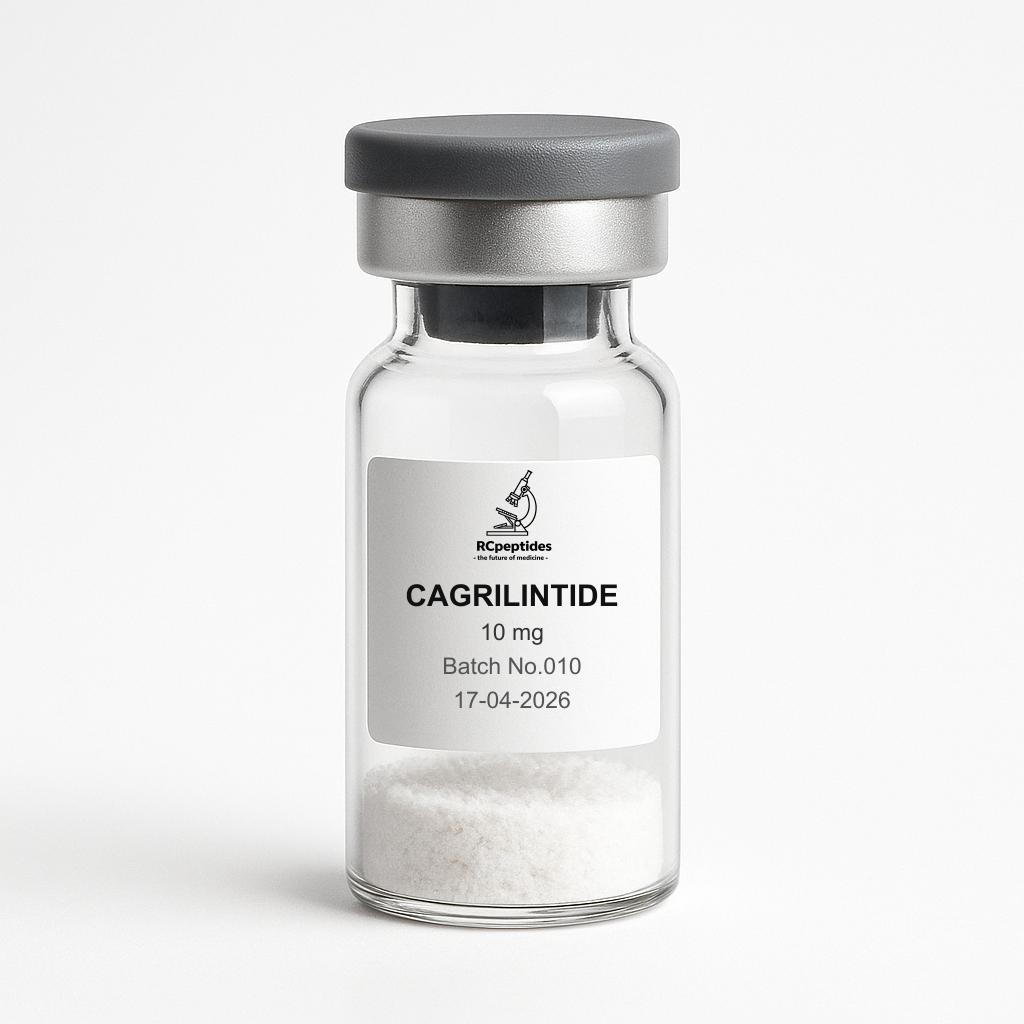
Cagrilintide 10mg vial — Cagrilintide is a long-acting amylin analogue investigated for its effects on satiety and body-weight regulation. It belongs to a different hormone pathway from GLP-1 agonists. Its relevance alongside GLP research comes from complementary biology and combination trials, not from cagrilintide being a GLP-1 agonist itself.
1. Compound and product overview
| Detail | Description |
|---|---|
| Compound | Cagrilintide (AM833) |
| Class / target | Long-acting amylin analogue; amylin/calcitonin receptor pharmacology |
| Labelled presentation | Cagrilintide 10mg vial |
| Research focus | Satiety signalling, body-weight regulation and combination research |
2. Mechanism and biological rationale
Amylin is normally co-secreted with insulin and participates in meal-related signalling. Amylin receptors consist of a calcitonin receptor associated with receptor activity-modifying proteins. Cagrilintide was developed to engage this receptor family with prolonged activity. Describing this pharmacology as a GLP-1/glucagon or GLP-1/GIP mechanism would identify the wrong targets.
Satiety, food intake and gastric emptying are related but distinct biological readouts. Receptor activation in an assay does not predict the size of a clinical weight response on its own. Combination studies add another layer: CagriSema is coadministered cagrilintide and semaglutide, meaning two active compounds with different targets. A vial containing cagrilintide alone is not CagriSema.
3. Benefits and effects studied
The table describes endpoints investigated in the cited research. The evidence level and study setting matter: findings for a study compound or pharmaceutical formulation do not establish the same outcomes for this catalogue material.
| Research area | Findings and evidence limits |
|---|---|
| Weight change with cagrilintide alone | A 26-week randomized phase 2 trial enrolled 706 adults. Mean weight reductions across cagrilintide groups were 6.0–10.8%, compared with 3.0% for placebo. The highest cagrilintide group had a 10.8% reduction versus 9.0% with the active liraglutide comparator. |
| Combined amylin and GLP-1 pathways | The 68-week REDEFINE-1 trial reported mean weight change of −20.4% with combined cagrilintide–semaglutide versus −3.0% with placebo. This result belongs to the combination and cannot be attributed to this single compound alone. |
| Satiety-related research | Amylin receptor biology provides a rationale for studying food-intake and meal-response signalling. Such mechanistic experiments do not establish a guaranteed appetite or weight effect in people. |
| Tolerability | Gastrointestinal events were common in the phase 2 programme. A useful interpretation includes adverse events and discontinuations alongside weight endpoints, rather than treating a favourable mean result as universal tolerability. |
4. Evidence in context
The monotherapy and combination trials answer different questions. Cagrilintide-alone evidence should be used to describe cagrilintide alone; studies involving semaglutide require that second compound to be identified explicitly. Their durations, participant selection and statistical handling also differ, so the percentages are not a direct ranking of standalone treatments.
The phase 2 study provides a controlled clinical signal for the investigational formulation. REDEFINE-1 extends the evidence for combining two pathways, but does not validate arbitrary mixtures, relative quantities or research-vial preparations. Mechanistic complementarity is a research rationale, not a preparation instruction or proof that any two materials will reproduce a trial formulation.
5. Product identity and laboratory considerations
Match the product name and labelled amount to the batch documentation before selecting a material for an experiment. Identity, purity and measured content answer different questions: a purity percentage alone does not establish the amount of the named compound, its biological activity, or the absence of every possible contaminant.
Use the original certificate where available to check the tested batch, analytical method and reported results. A result belongs to the sample and tests described in that report; it should not be extended to a different batch or treated as a clinical evaluation. Storage, solvent compatibility and stability after preparation require the documentation for the actual material and the conditions of the planned assay. A vial size is a product specification, not a treatment schedule.
6. Research scope
This listing supplies a research material. Published clinical studies use defined formulations, eligibility criteria, monitoring and analytical controls that are not established by this product listing. Laboratory observations, biomarkers and clinical outcomes should be interpreted separately. The cited literature provides background for scientific evaluation; it is not evidence that this particular product has been tested for therapeutic efficacy or safety.
Selected scientific references
- Lau et al. — Cagrilintide monotherapy phase 2 trial (2021)
- REDEFINE-1 — Coadministered cagrilintide and semaglutide (2025)
For in vitro laboratory research use only. Not for human or veterinary use. Not intended for diagnosis, treatment or prevention of disease.
Price: €80.00
Collection: GLP
Batch test results and COAs
Research use only. Not for human consumption.