Enclomiphene Citrate 100x12.5mg
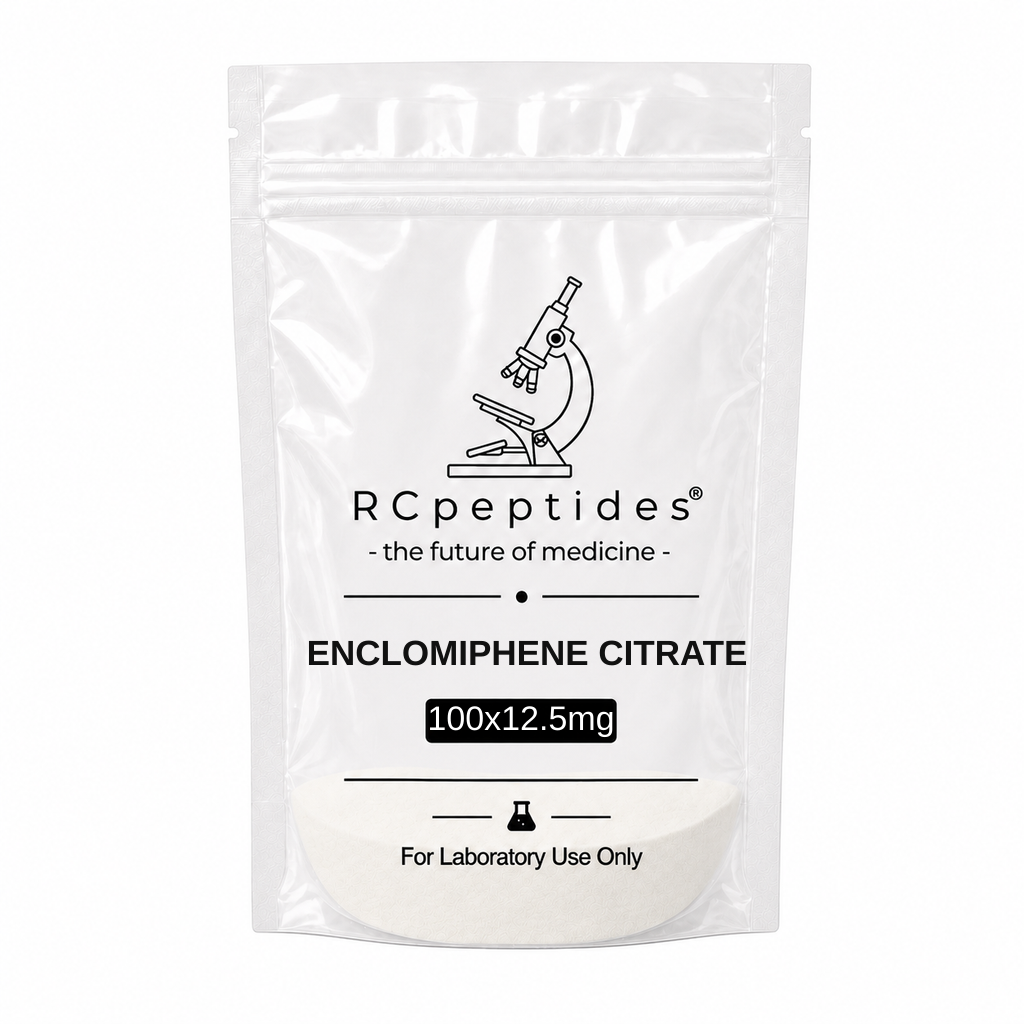
NOT FOR HUMAN CONSUMPTION
Enclomiphene is the trans (E) isomer of clomiphene citrate and acts as a selective estrogen-receptor modulator (SERM). In men, it blocks estradiol’s negative feedback at the hypothalamus/pituitary, raising GnRH → LH/FSH, which in turn stimulates endogenous testosterone production by Leydig cells while maintaining spermatogenesis (via FSH/Sertoli). Unlike exogenous testosterone, enclomiphene does not suppress the HPG axis and is commonly used off-label for men with functional/secondary hypogonadism who desire fertility preservation. (Not FDA/EMA-approved as a branded drug.)
Additional Benefits of Enclomiphene Now Under Investigation
| Benefit | Key take-aways |
|---|---|
| 1 Restores physiologic testosterone with fertility preserved | In men with secondary hypogonadism, enclomiphene increases TT/FT to mid-normal while maintaining or improving sperm counts, unlike TRT which often induces azoospermia. |
| 2 Normalizes LH/FSH pulsatility | Improves pituitary responsiveness and diurnal T dynamics (morning peak), supporting libido/energy improvements without exogenous androgen peaks. |
| 3 Metabolic profile neutrality vs TRT | Generally weight-neutral with modest improvements in insulin sensitivity/lipids in some cohorts; far less erythrocytosis than TRT. |
| 4 Symptom relief (sexual & vitality) | Reported gains in sexual desire, erectile function, mood, and fatigue parallel biochemical T normalization. |
| 5 Estradiol balance | Often yields physiologic E2 via aromatization of endogenous T; avoids extreme E2 suppression seen with AIs. Aromatase inhibitor can be added if E2 becomes high. |
| 6 Testicular volume maintenance | By stimulating intratesticular T, enclomiphene helps preserve testicular size vs the shrinking frequently seen with TRT. |
| 7 Transition off AAS/TRT | Used in post-cycle or TRT cessation plans to re-start the axis (with or without hCG); evidence is mainly observational. |
| 8 Sleep apnea/BP neutrality (relative) | Less fluid retention and hematocrit rise than TRT → lower risk of OSA or BP worsening; still monitor in predisposed patients. |
| 9 Female applications (exploratory) | In women, clomiphene is established for ovulation induction; enclomiphene-specificprograms explored ovulation induction with a shorter tissue persistence vs zuclomiphene, but it is not standard of care. |
2. Molecular Mechanism of Action
2.1 Receptor pharmacodynamics
-
SERM activity (ERα/ERβ): Antagonist at hypothalamus/pituitary → ↑ GnRH → ↑ LH/FSH.
-
Testis: LH → Leydig → testosterone; FSH → Sertoli → spermatogenesis.
-
Enclomiphene vs zuclomiphene: Enclomiphene has shorter half-life, less estrogenic persistence, and a cleaner antiestrogenic profile centrally.
2.2 Down-stream biology
| Pathway | Details |
|---|---|
| GnRH–LH/FSH axis up-regulation | Functional outcome: Endogenous T ↑, sperm production preserved Context: Male hypogonadism |
| Aromatization of T → E2 | Functional outcome: Physiologic estradiol for bone/libido Context: Systemic |
| SHBG modulation | Functional outcome: Mild ↑/↔ depending on baseline Context: Liver |
3. Pharmacokinetics
-
Route: Oral tablet (usually compounded).
-
Onset: T rises within weeks; sperm parameters respond over 2–3+ months.
-
Half-life: Shorter than zuclomiphene (days vs weeks), reducing long tail accumulation typical of clomiphene mixes.
-
Dosing used clinically (off-label): 6.25–25 mg daily (common: 12.5–25 mg QD), or 25 mg QOD, titrated to mid-normal TT/FT and symptom control.
4. Clinical Evidence (high-level)
-
Secondary hypogonadism (men): RCTs and open-label studies show TT/FT increases comparable to low-dose TRT, with LH/FSH maintained and sperm counts preserved or improved.
-
Symptoms/QoL: Improvements in sexual function and vitality correlate with biochemical response.
-
Metabolic labs: Neutral to mildly favorable effects on lipids/insulin sensitivity; far lower rates of erythrocytosisthan TRT.
-
Female fertility: Clomiphene citrate remains standard; enclomiphene monotherapy is investigational.
Evidence quality note: Solid male endocrine data for biochemical efficacy; fewer large, long-term outcome trials than for TRT. Regulatory approval attempts in the US previously received complete response letters; enclomiphene remains unapproved as a branded product.
5. Emerging Clinical Interests
| Field | Details |
|---|---|
| Functional hypogonadism (obesity, opioids, OSA treated) | Rationale: Restore axis while preserving fertility Status: Real-world/off-label |
| Adjunct with hCG | Rationale: hCG for intratesticular T + enclomiphene for pituitary tone Status: Practice-based |
| Post-TRT/AAS recovery | Rationale: Re-engage axis with SERM ± hCG Status: Observational |
| Male infertility with low-normal T | Rationale: Improve T and spermatogenesis before ART Status: Ongoing practice research |
6. Safety and Tolerability
-
Common: Headache, hot flashes, mood lability/irritability, GI upset, transient visual disturbances (rare; caution with night driving).
-
Endocrine: Possible E2 increase → breast tenderness/gynecomastia in sensitive men; consider dose adjustment or low-dose AI if symptomatic.
-
Hematologic: Erythrocytosis uncommon vs TRT, but check CBC.
-
Thromboembolic risk: SERMs carry a theoretical VTE risk (low in men but screen for history/family risk).
-
Hepatic: Rare transaminase elevations—obtain baseline and periodic LFTs.
-
Psych: Anxiety/irritability in a minority—monitor.
-
Ocular: Very rare optic events have been described with clomiphene-class SERMs—stop if visual symptomsoccur.
-
Contraindications: Active liver disease, prior VTE, uncontrolled polycythemia, hypersensitivity to SERM class.
-
Pregnancy: Contraindicated (SERM class).
-
Anti-doping: SERMs are prohibited by WADA (S4).
Comparative safety/efficacy matrix
| Feature | Details |
|---|---|
| Axis effect | Enclomiphene: Stimulates LH/FSH Clomiphene citrate (mix): Stimulates (isomer mix; longer tail) TRT (exogenous T): SuppressesLH/FSH hCG: Stimulates Leydig (LH-mimic) |
| Fertility | Enclomiphene: Preserved Clomiphene citrate (mix): Preserved TRT (exogenous T): Often suppressed hCG: Preserved; supports spermatogenesis (±FSH) |
| Erythrocytosis | Enclomiphene: Low Clomiphene citrate (mix): Low–mod TRT (exogenous T): Higher hCG: Low |
| Gynecomastia risk | Enclomiphene: E2-related (dose-dependent) Clomiphene citrate (mix): Similar TRT (exogenous T): Aromatization of exogenous T hCG: Aromatization from ↑T |
| Visual/neurologic AEs | Enclomiphene: Rare SERM-class Clomiphene citrate (mix): Slightly more (zuclo tail) TRT (exogenous T): Uncommon hCG: Uncommon |
| Regulatory status | Enclomiphene: Unapproved; off-label via compounding Clomiphene citrate (mix): Approved (female), off-label (male) TRT (exogenous T): Approved hCG: Approved |
7. Regulatory Landscape
-
Not FDA/EMA-approved as a branded product for male hypogonadism (prior NDA efforts were not approved).
-
Male hypogonadism treatment guidelines typically endorse TRT for confirmed organic deficiency; SERMs (clomiphene/enclomiphene) are discussed off-label for secondary hypogonadism with fertility intent.
8. Practical Use (clinic playbook)
-
Who’s a good candidate? Men with secondary/functional hypogonadism (low morning TT/FT with low/normal LH/FSH), desiring fertility preservation, without major SERM contraindications.
-
Baseline work-up: TT/FT (2 mornings), LH/FSH, E2, SHBG, prolactin, TSH, CBC, LFTs, semen analysis if fertility relevant; assess OSA, meds (opioids), obesity.
-
Dosing: Start 12.5 mg QD (range 6.25–25 mg). Recheck labs at 4–6 weeks; titrate to mid-normal TT/FT and symptom relief.
-
Follow-up (q8–12 wks early, then q3–6 mo): TT/FT, E2, LH/FSH, CBC, LFTs, BP/weight, symptoms; semen parameters every 3–6 months if fertility is an endpoint.
-
Adjuncts: If E2 climbs with symptoms, consider dose reduction, EOD dosing, or low-dose AI; if T response is blunted, consider add-on hCG.
-
Stop/hold if: Visual symptoms, VTE signs, persistent mood instability, significant LFT rise, or absent biochemical/clinical response after adequate trial.
Selected References
-
Journal of Clinical Endocrinology & Metabolism — SERM therapy for male secondary hypogonadism; enclomiphene vs clomiphene pharmacology.
-
Fertility and Sterility; Andrology — Effects on spermatogenesis, semen parameters, and fertility outcomes.
-
Endocrine Reviews; Clinical Endocrinology — Algorithms for diagnosing functional hypogonadism and fertility-preserving strategies.
-
Urology; BJU International — Comparative data: enclomiphene vs TRT on TT/FT, LH/FSH, hematologic and metabolic outcomes.
-
Drug Testing & Analysis; WADA Code — SERM prohibition in sport.
For in vitro laboratory research use only. Not for human or veterinary use. Not intended for diagnosis, treatment or prevention of disease.
Price: €75.00
Collection: SARMs
Batch test results and COAs
Research use only. Not for human consumption.