Epitalon 10mg vial
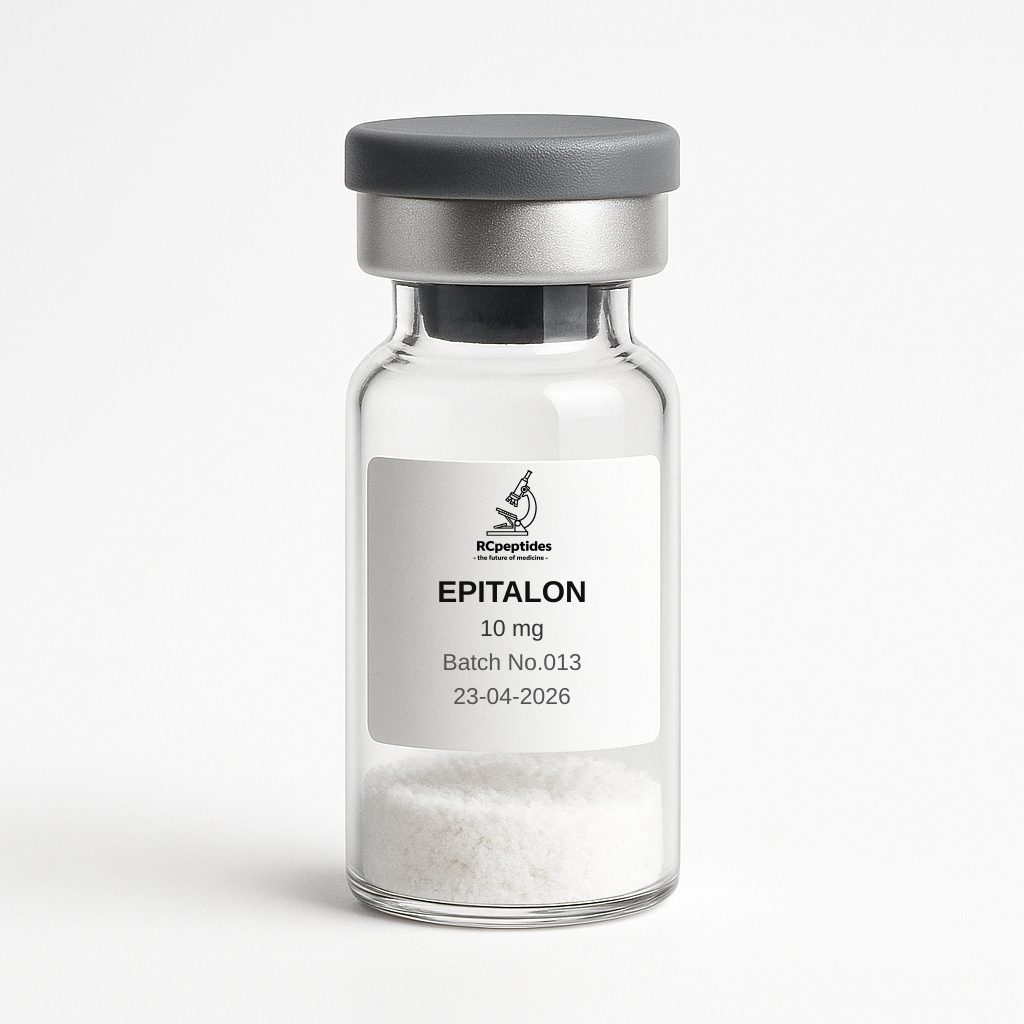
Epitalon 10mg vial — Epitalon, also spelled Epithalon, is a synthetic tetrapeptide with the sequence alanine–glutamate–aspartate–glycine. Its correct one-letter abbreviation is AEDG. It is chemically distinct from epithalamin, a pineal-derived peptide preparation, and the two names should not be treated as interchangeable study materials.
1. Compound and product overview
| Detail | Description |
|---|---|
| Compound | Epitalon / Epithalon; Ala–Glu–Asp–Gly (AEDG) |
| Class / target | Synthetic tetrapeptide investigated in cellular ageing models |
| Labelled presentation | Epitalon 10mg vial |
| Research focus | Telomerase-related readouts, telomere biology and cell proliferation |
2. Mechanism and biological rationale
Early cell-culture work investigated whether Epitalon altered telomerase-related expression and telomere measurements. Telomerase activity, telomere length and the number of times a cultured cell population divides are related but different endpoints. A result for one does not establish a longer human lifespan.
The amino-acid sequence identifies the material more reliably than broad terms such as “pineal peptide” or “anti-ageing peptide.” Results from extracts, modified derivatives or mixtures require their own interpretation. In particular, observations from an epithalamin preparation cannot be assumed to belong to the defined AEDG tetrapeptide.
3. Benefits and effects studied
The table describes endpoints investigated in the cited research. The evidence level and study setting matter: findings for a study compound or pharmaceutical formulation do not establish the same outcomes for this catalogue material.
| Research area | Findings and evidence limits |
|---|---|
| Telomerase-related findings | A 2003 study in human fetal fibroblast culture reported telomerase-related expression, enzymatic activity and telomere elongation after Epithalon exposure. These were cellular measurements, not a human longevity trial. |
| Cell-population proliferation | A subsequent 2004 study examined the proliferative potential of human fetal fibroblasts. Extending division in a culture model does not establish improved health, function or lifespan in a person. |
| Identity-specific research | Defined Epitalon, pineal extracts and chemically modified analogues must be evaluated separately. Sharing a historical development context does not make their effects or safety profiles equivalent. |
| Limits of anti-ageing claims | The cited work does not demonstrate prevention of cancer, reversal of ageing, improved fertility or a validated sleep treatment. Telomere length alone is not a complete measure of beneficial ageing outcomes. |
4. Evidence in context
The papers summarized here provide hypotheses and laboratory observations. Human-derived cells remain an in vitro system rather than evidence from treated human participants. Measurements can vary with cell type, assay method and culture conditions, making independent replication and orthogonal readouts important.
A more complete evaluation would distinguish peptide identity, telomerase activity, telomere length, proliferation and genomic stability rather than collapsing them into a single rejuvenation claim. The 10mg and 50mg catalogue presentations represent different labelled amounts of the same named tetrapeptide, not different clinical protocols.
5. Product identity and laboratory considerations
Match the product name and labelled amount to the batch documentation before selecting a material for an experiment. Identity, purity and measured content answer different questions: a purity percentage alone does not establish the amount of the named compound, its biological activity, or the absence of every possible contaminant.
Use the original certificate where available to check the tested batch, analytical method and reported results. A result belongs to the sample and tests described in that report; it should not be extended to a different batch or treated as a clinical evaluation. Storage, solvent compatibility and stability after preparation require the documentation for the actual material and the conditions of the planned assay. A vial size is a product specification, not a treatment schedule.
6. Research scope
This listing supplies a research material. Published clinical studies use defined formulations, eligibility criteria, monitoring and analytical controls that are not established by this product listing. Laboratory observations, biomarkers and clinical outcomes should be interpreted separately. The cited literature provides background for scientific evaluation; it is not evidence that this particular product has been tested for therapeutic efficacy or safety.
Selected scientific references
- Khavinson et al. — Epithalon and telomerase in human somatic cell culture (2003)
- Khavinson et al. — Epithalon and the division limit of human somatic cells (2004)
For in vitro laboratory research use only. Not for human or veterinary use. Not intended for diagnosis, treatment or prevention of disease.
Price: €25.00
Collection: Peptides
Batch test results and COAs
Research use only. Not for human consumption.