GHK-CU 50mg vial
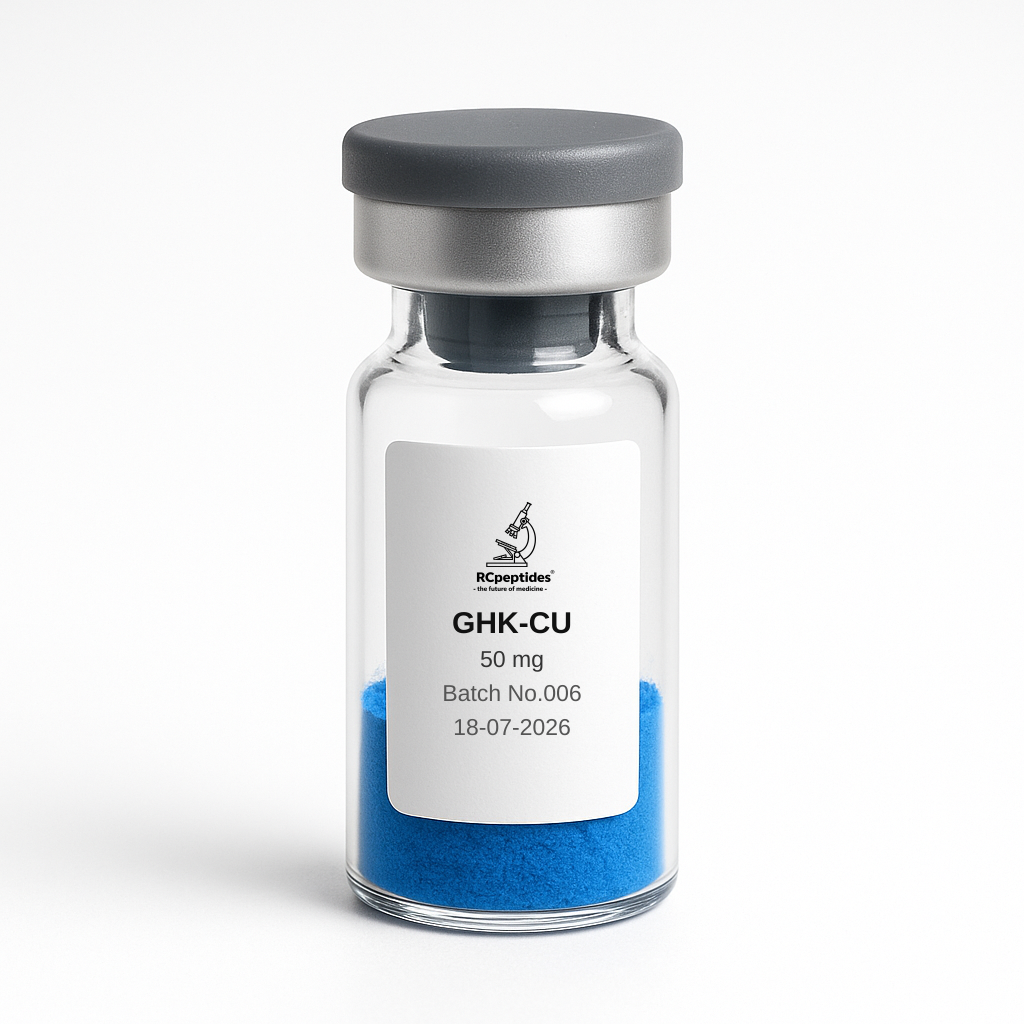
GHK-CU 50mg vial — GHK-Cu is the copper complex of the tripeptide glycine–histidine–lysine. It has been investigated in skin and connective-tissue biology, including fibroblast models of extracellular-matrix synthesis. The research vial is distinct from a finished cosmetic formula, and its effects cannot be inferred from the name of a cosmetic ingredient alone.
1. Compound and product overview
| Detail | Description |
|---|---|
| Compound | Glycyl-L-histidyl-L-lysine copper complex (GHK-Cu) |
| Class / target | Copper-binding tripeptide; sequence Gly–His–Lys |
| Labelled presentation | GHK-CU 50mg vial |
| Research focus | Fibroblast biology, extracellular matrix and peptide–copper interactions |
2. Mechanism and biological rationale
GHK can coordinate copper, creating a peptide–metal complex whose behaviour depends on its chemical environment. Copper availability, competing ligands and medium composition are relevant to experiments. Free GHK, GHK-Cu and AHK-Cu are different materials: AHK uses alanine as its first amino acid, whereas GHK uses glycine.
A primary fibroblast study reported stimulation of collagen synthesis by GHK-Cu. Collagen production is one component of extracellular-matrix biology, alongside degradation, organization and tissue mechanics. Increasing a synthesis readout in cultured cells is not the same as demonstrating wrinkle reduction, wound closure or restored tissue strength in people.
3. Benefits and effects studied
The table describes endpoints investigated in the cited research. The evidence level and study setting matter: findings for a study compound or pharmaceutical formulation do not establish the same outcomes for this catalogue material.
| Research area | Findings and evidence limits |
|---|---|
| Collagen synthesis | Maquart and colleagues reported increased collagen synthesis in cultured fibroblasts. The finding supports investigation of matrix biology in that experimental setting. |
| Peptide–copper interactions | The complex provides a model for evaluating how peptide coordination affects copper-related biological responses. Colour alone is not proof of composition, identity or biological activity. |
| Skin-formulation research | A finished topical formulation introduces additional questions, including stability and skin delivery. Results for a formulated cosmetic cannot be automatically assigned to a raw research vial. |
| Clinical interpretation | The cited cell-culture result does not establish treatment of burns, diabetic ulcers, hair loss or internal-organ disease. It also does not establish a safe injectable or oral-use regimen. |
4. Evidence in context
Descriptions of copper peptides often combine findings from different sequences and preparations. This listing keeps the evidence specific to Gly–His–Lys complexed with copper. Research on AHK-Cu hair-follicle cultures is a separate body of evidence and should retain its own compound identity.
For a laboratory comparison, assess the peptide specification, copper-related composition and concentration basis. A nominal 50mg or 100mg product quantity does not specify the amount of elemental copper alone. Analytical purity also does not establish that an experimental solution retains the same complex under every pH, solvent or storage condition.
5. Product identity and laboratory considerations
Match the product name and labelled amount to the batch documentation before selecting a material for an experiment. Identity, purity and measured content answer different questions: a purity percentage alone does not establish the amount of the named compound, its biological activity, or the absence of every possible contaminant.
Use the original certificate where available to check the tested batch, analytical method and reported results. A result belongs to the sample and tests described in that report; it should not be extended to a different batch or treated as a clinical evaluation. Storage, solvent compatibility and stability after preparation require the documentation for the actual material and the conditions of the planned assay. A vial size is a product specification, not a treatment schedule.
6. Research scope
This listing supplies a research material. Published clinical studies use defined formulations, eligibility criteria, monitoring and analytical controls that are not established by this product listing. Laboratory observations, biomarkers and clinical outcomes should be interpreted separately. The cited literature provides background for scientific evaluation; it is not evidence that this particular product has been tested for therapeutic efficacy or safety.
Selected scientific references
- Maquart et al. — GHK-Cu and collagen synthesis in fibroblast cultures (1988)
- Pyo et al. — Separate AHK-Cu hair-follicle study, included to distinguish peptide identities (2007)
For in vitro laboratory research use only. Not for human or veterinary use. Not intended for diagnosis, treatment or prevention of disease.
Price: €35.00
Collection: Peptides
Batch test results and COAs
Research use only. Not for human consumption.