GLP-3 20mg vial
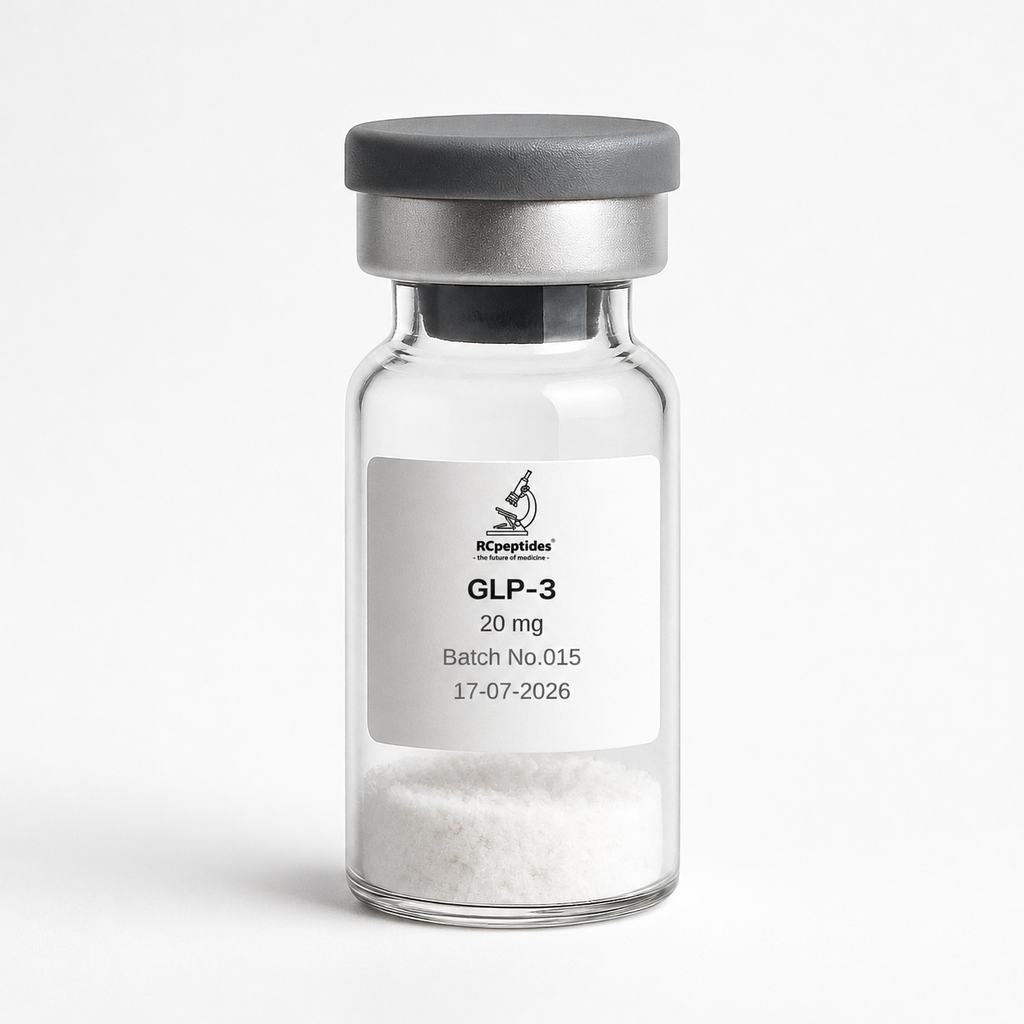
GLP-3 20mg vial — Retatrutide is a peptide investigated for combined activity at three metabolic hormone receptors: GIP, GLP-1 and glucagon. The catalogue name “GLP-3” refers to this triple-agonist research compound; it is not the name of a separate GLP-3 receptor. Different vial sizes represent different labelled quantities of the same named compound.
1. Compound and product overview
| Detail | Description |
|---|---|
| Compound | Retatrutide (LY3437943); catalogue name GLP-3 |
| Class / target | Peptide agonist of GIP, GLP-1 and glucagon receptors |
| Labelled presentation | GLP-3 20mg vial |
| Research focus | Multi-receptor metabolic signalling, body-weight endpoints and liver-fat research |
2. Mechanism and biological rationale
GIP and GLP-1 receptor signalling is relevant to glucose-dependent insulin secretion and the coordination of nutrient responses. GLP-1 signalling also contributes to appetite regulation. Glucagon receptor activity adds a distinct hepatic and energy-metabolism pathway. Retatrutide brings these activities together in one molecule; describing it simply as a stronger GLP-1 agonist misses that distinction.
The balance of these pathways depends on the assay system, receptor expression and exposure. A change in one signalling readout does not demonstrate an identical change in appetite, energy expenditure or body composition. Receptor-level experiments and clinical weight-change studies therefore address different questions. Comparisons with single- or dual-receptor agonists need matched experimental conditions rather than a ranking based on receptor count.
3. Benefits and effects studied
The table describes endpoints investigated in the cited research. The evidence level and study setting matter: findings for a study compound or pharmaceutical formulation do not establish the same outcomes for this catalogue material.
| Research area | Findings and evidence limits |
|---|---|
| Body-weight change | A randomized phase 2 trial in 338 adults reported a mean weight reduction of up to 24.2% at 48 weeks, versus 2.1% with placebo. These are group results for the study formulation, not an expected outcome from a research vial. |
| Longer-term weight endpoints | The 80-week phase 3 TRIUMPH-1 report describes mean reductions of 17.6–25.0% across treatment groups versus 3.9% with placebo under the treatment-regimen estimand. The separate efficacy-estimand figures should not be substituted into the same comparison. |
| Liver fat | A randomized phase 2a substudy in 98 participants with metabolic dysfunction-associated steatotic liver disease assessed liver fat by MRI and found reductions with retatrutide. Reduced liver fat is not, by itself, proof of fibrosis reversal or prevention of liver-related events. |
| Tolerability and interpretation | Gastrointestinal adverse events were reported in clinical development. Weight-loss endpoints do not establish risk-free use, guaranteed preservation of muscle, or a cardiovascular outcome benefit. |
4. Evidence in context
The phase 2 obesity trial, phase 2a liver-fat substudy and phase 3 TRIUMPH-1 trial provide different evidence. They differ in population, duration and endpoints, so their percentages should not be combined into a single forecast. The liver study was a selected subgroup rather than a separate confirmation of every obesity-trial outcome.
An estimand defines the question a trial analysis is designed to answer. Treatment-regimen estimates account for the trial’s specified handling of discontinuation and other events; efficacy estimates address a different treatment-adherence scenario. Reporting that distinction is necessary when comparing the 80-week results. Retatrutide remains an investigational compound in the cited development programme, and the commercial research presentation is not the clinical trial formulation.
5. Product identity and laboratory considerations
Match the product name and labelled amount to the batch documentation before selecting a material for an experiment. Identity, purity and measured content answer different questions: a purity percentage alone does not establish the amount of the named compound, its biological activity, or the absence of every possible contaminant.
Use the original certificate where available to check the tested batch, analytical method and reported results. A result belongs to the sample and tests described in that report; it should not be extended to a different batch or treated as a clinical evaluation. Storage, solvent compatibility and stability after preparation require the documentation for the actual material and the conditions of the planned assay. A vial size is a product specification, not a treatment schedule.
6. Research scope
This listing supplies a research material. Published clinical studies use defined formulations, eligibility criteria, monitoring and analytical controls that are not established by this product listing. Laboratory observations, biomarkers and clinical outcomes should be interpreted separately. The cited literature provides background for scientific evaluation; it is not evidence that this particular product has been tested for therapeutic efficacy or safety.
Selected scientific references
- Jastreboff et al. — Retatrutide phase 2 obesity trial (2023)
- TRIUMPH-1 — Retatrutide phase 3 obesity trial (2026)
- Lilly Medical — TRIUMPH-1 results and estimands
- Sanyal et al. — Retatrutide and liver fat, randomized phase 2a trial (2024)
For in vitro laboratory research use only. Not for human or veterinary use. Not intended for diagnosis, treatment or prevention of disease.
Price: €120.00
Collection: GLP
Batch test results and COAs
Research use only. Not for human consumption.