Gonadorelin 10mg vial
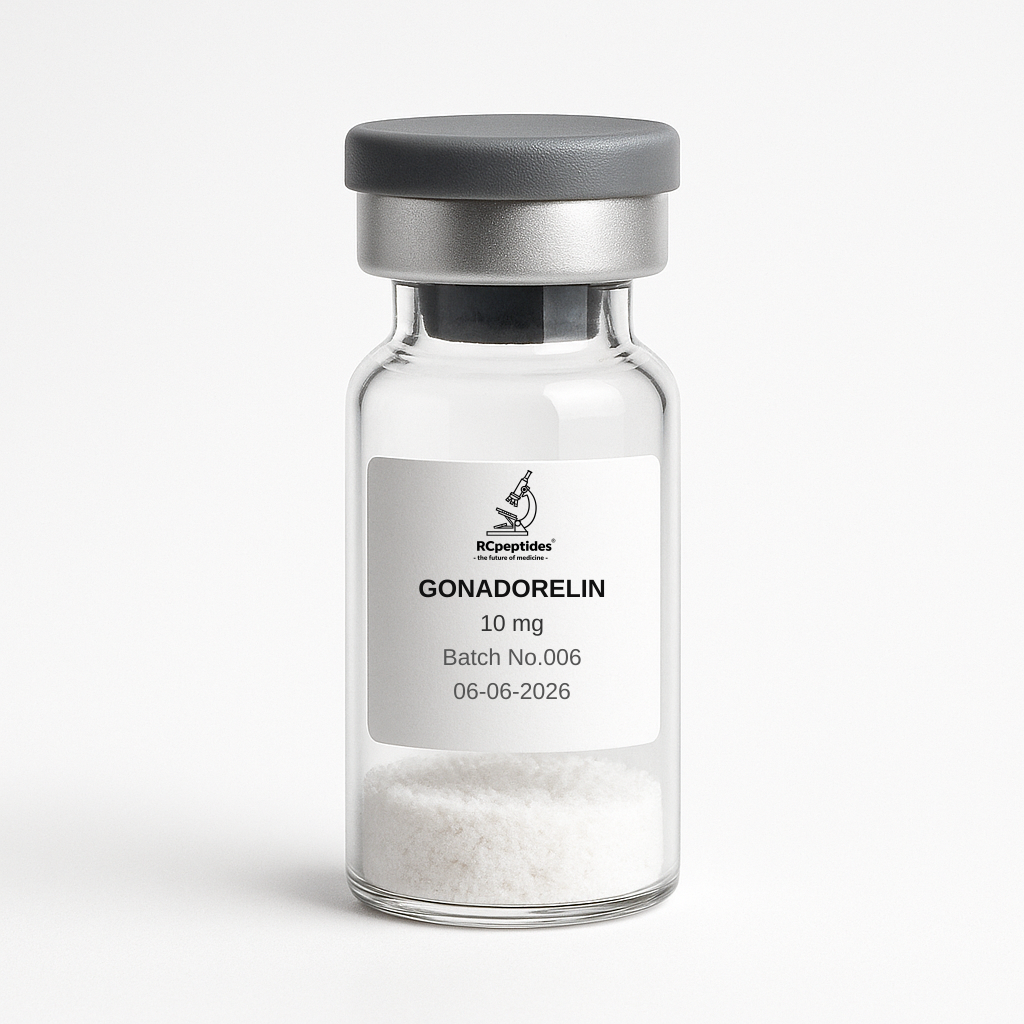
NOT FOR HUMAN CONSUMPTION
Gonadorelin is the synthetic form of endogenous gonadotropin-releasing hormone (GnRH, LHRH)—a decapeptide secreted in pulses by the hypothalamus. It binds GnRH receptors on pituitary gonadotrophs to trigger luteinizing hormone (LH) and follicle-stimulating hormone (FSH) release, which in turn regulate sex-steroid production and gametogenesis. Clinically, gonadorelin is approved in several regions as a diagnostic agent for assessing pituitary gonadotroph function (e.g., delayed puberty, amenorrhea, hypogonadism). Therapeutically, pulsatile infusion can restore fertility in hypothalamic hypogonadism; continuous exposure desensitizes the receptor (the basis of long-acting GnRH-agonist therapy), but gonadorelin itself is short-acting.
Additional Benefits of Gonadorelin Now Under Investigation
| Benefit | Key take-aways |
|---|---|
| 1 Physiologic ovulation in hypothalamic amenorrhea |
Pulsatile SC/IV delivery (q60–90 min) reconstitutes LH/FSH pulsatility, yielding mono-follicular ovulation with a low multiple-gestation and OHSS risk compared with exogenous gonadotropins. Fertility and Sterility; Human Reproduction |
| 2 Restoration of spermatogenesis in congenital/functional HH | In men with GnRH deficiency (e.g., Kallmann) or functional hypothalamic suppression, pulsatile therapy initiates testicular growth and spermatogenesis, providing a physiologic alternative to hCG/hMG. Journal of Clinical Endocrinology & Metabolism; Andrology |
| 3 Diagnostic discrimination of hypothalamic vs pituitary disease |
Single-bolus GnRH testing (e.g., 100 µg IV) helps differentiate pituitary gonadotroph failure(blunted LH/FSH) from hypothalamic causes (delayed but present response). Endocrine Reviews; JCEM |
| 4 Luteal-phase optimization in restored cycles | With pulsatile induction, luteal function is often adequate; when suboptimal, physiologic progesterone support can normalize implantation milieu while maintaining low hyperstimulation risk. Reproductive BioMedicine Online; Obstetrics & Gynecology |
| 5 Lower cumulative iatrogenic risks vs gonadotropins | Physiologic follicular recruitment reduces multifetal pregnancy, cycle cancellation, and OHSS, potentially improving safety-per-pregnancy metrics in HH. Fertility and Sterility; Human Reproduction Update |
| 6 Functional hypothalamic amenorrhea (FHA) in athletes/stress | In FHA refractory to lifestyle intervention, temporary pulsatile GnRH can re-establish cyclesand mitigate hypoestrogenic sequelae (bone, urogenital) without supraphysiologic gonadotropin exposure. Sports Medicine; Endocrine Connections |
| 7 Pubertal axis assessment | In delayed or ambiguous puberty, GnRH testing—alone or with sex-steroid priming—improves diagnostic yield and risk-stratifies for progression vs pathology. Pediatrics; European Journal of Endocrinology |
| 8 Post-pituitary surgery surveillance | Serial GnRH tests can track gonadotroph reserve during recovery after pituitary adenoma therapy, complementing basal gonadotropins and inhibin B/AMH. Pituitary; Clinical Endocrinology |
| 9 Research tool for frequency-coding biology | Controlled pulse-frequency modulation (faster → LH-biased, slower → FSH-biased) enables study of gonadotropin subunit transcription and personalized induction paradigms. Nature Reviews Endocrinology; Molecular Endocrinology |
2. Molecular Mechanism of Action
2.1 Receptor Pharmacodynamics
Gonadorelin binds the GnRH (GNRHR) GPCR on pituitary gonadotrophs → Gαq/11–PLCβ–IP₃/DAG–Ca²⁺/PKCsignalling → exocytosis of pre-formed LH/FSH and transcriptional up-regulation of CGA, LHB, FSHB.
-
Pulsatile exposure preserves receptor responsiveness and frequency-codes LH vs FSH synthesis.
-
Continuous exposure leads to receptor desensitization/internalization and suppression of LH/FSH.
2.2 Down-stream Biology
| Pathway | Details |
|---|---|
| IP₃/Ca²⁺, PKC, ERK | Functional outcome: Acute LH/FSH release; gene transcription of gonadotropin subunits Context: Pituitary |
| LH → theca/Leydig | Functional outcome: ↑ Androgen (substrate for estradiol; testosterone production) Context: Ovary/testis |
| FSH → granulosa/Sertoli | Functional outcome: Folliculogenesis, aromatase; spermatogenesis support Context: Ovary/testis |
| Steroid feedback | Functional outcome: E2/T, inhibin, progesterone fine-tune GnRH/LH/FSH Context: HPG axis |
3. Pharmacokinetics
-
Route: IV/SC for testing; pulsatile SC or IV via portable pump for therapy.
-
Onset/peak: LH rises within ~15–30 min of a bolus; FSH lag modestly longer.
-
Half-life: ~2–4 minutes (IV); short systemic exposure mandates pulsatile delivery for therapeutic use.
-
Clearance: Peptidase degradation; renal/hepatic peptide catabolism; no CYP interactions.
4. Pre-clinical and Translational Evidence
4.1 Female Hypothalamic Hypogonadism
Pulsatile GnRH achieves high ovulation and pregnancy rates with monofollicular cycles and very low OHSS, often favored when a physiologic approach is desired or when PCOS is absent.
4.2 Male Hypogonadotropic Hypogonadism
In congenital GnRH deficiency and functional HH, pulsatile therapy restores intratesticular testosterone, Sertoli cell function, and spermatogenesis; time-to-sperm varies by onset/severity and prior cryptorchidism.
4.3 Diagnostics
Standardized GnRH stimulation protocols assist in delayed puberty, amenorrhea, post-surgical pituitary assessment, and central precocious puberty (historically)—now often replaced by long-acting agonist tests where available.
5. Emerging Clinical Interests
| Field | Details |
|---|---|
| Functional HA in athletes | Rationale: Reversible hypothalamic suppression; fertility desire Current status: Specialized centers use pulsatile therapy after lifestyle care |
| Personalized pulse-coding | Rationale: Titrate LH/FSH balance via frequency Current status: Under investigation with smart pumps |
| Oncofertility (post-therapy HH) | Rationale: Axis reconstitution after cranial RT/chemo Current status: Case-series/feasibility |
| Assisted reproduction adjuncts | Rationale: Physiologic trigger strategies and luteal support Current status: Niche, protocol-dependent |
6. Safety and Tolerability
-
Common: Flushing, headache, transient lower abdominal discomfort; injection-site erythema with pumps.
-
Cycle risks (women): Low rates of multiples and OHSS compared with exogenous gonadotropins; monitor follicles/estradiol.
-
Men: Gynecomastia uncommon; monitor testicular volume, sperm parameters, and hematocrit as T normalizes.
-
Contraindications: Pregnancy, hormone-sensitive malignancy, uncontrolled pituitary disease, hypersensitivity to GnRH/analogs.
-
Operational: Pump therapy requires aseptic technique, catheter care, and adherence.
Comparative safety matrix
| Concern | Details |
|---|---|
| Physiologic LH/FSH pattern | Gonadorelin (pulsatile): Yes (pulse-coded) Exogenous gonadotropins (hMG/FSH+hCG): No (pharmacologic) Long-acting GnRH agonists: No (suppression) |
| Multiples/OHSS in induction | Gonadorelin (pulsatile): Low Exogenous gonadotropins (hMG/FSH+hCG): Higher Long-acting GnRH agonists: N/A (suppressive) |
| Convenience | Gonadorelin (pulsatile): Pump/catheter burden Exogenous gonadotropins (hMG/FSH+hCG): Injections but simpler Long-acting GnRH agonists: Injections monthly/3-monthly |
| Typical use | Gonadorelin (pulsatile): HH fertility induction; diagnostics Exogenous gonadotropins (hMG/FSH+hCG): Broad ovulation induction; ART Long-acting GnRH agonists: Suppression (endometriosis, CPP, prostate Ca) |
7. Regulatory Landscape
-
Approved indication (many regions): Diagnostic testing of pituitary gonadotroph function (e.g., single-dose IV/SC).
-
Therapeutic use: Pulsatile GnRH for hypothalamic hypogonadism–related infertility practiced in specialized centers; availability varies by device access and local regulation.
-
Not indicated as chronic suppressive therapy—long-acting analogs fill that role.
8. Future Directions
-
Smart pumps & closed-loop dosing using real-time LH feedback to optimize pulse frequency and minimize monitoring.
-
Integration with lifestyle/energy-availability restoration in FHA to shorten time-to-menses and protect bone.
-
Biomarker panels (kisspeptin, inhibin B/AMH) to refine diagnosis and prognostication before committing to pump therapy.
-
Male protocols combining pulsatile GnRH with hCG/FSH to accelerate spermatogenic recovery in select phenotypes.
Selected References
-
Crowley W.F., Filicori M., et al. Pulsatile GnRH therapy in hypothalamic amenorrhea and hypogonadotropic hypogonadism. Journal of Clinical Endocrinology & Metabolism; Fertility and Sterility.
-
Hall J.E., Hayes F.J. Physiology of GnRH pulse frequency and gonadotropin synthesis. Endocrine Reviews; Molecular Endocrinology.
-
Bouchard P., et al. Diagnostic use of the GnRH (gonadorelin) stimulation test. JCEM; Pediatrics.
-
Martin K.A., et al. Functional hypothalamic amenorrhea—diagnosis and management. Human Reproduction Update; Endocrine Connections.
-
Pitteloud N., et al. Kallmann syndrome and congenital GnRH deficiency—restoration of fertility. Andrology; JCEM.
-
Tarlatzis B.C., et al. Ovulation induction strategies and OHSS prevention. Human Reproduction; Reproductive BioMedicine Online.
-
Melmed S., et al. Pituitary disease evaluation and post-surgical testing. Clinical Endocrinology; Pituitary.
-
Plant T.M., Marshall J.C. Puberty and GnRH neuroendocrinology. Endocrine Reviews.
-
Welt C.K., et al. Luteal support and implantation after physiologic induction. Obstetrics & Gynecology; Fertility and Sterility.
For in vitro laboratory research use only. Not for human or veterinary use. Not intended for diagnosis, treatment or prevention of disease.
Price: €50.00
Collection: Gonadotropins
Batch test results and COAs
Research use only. Not for human consumption.