IGF1-LR3 1mg vial
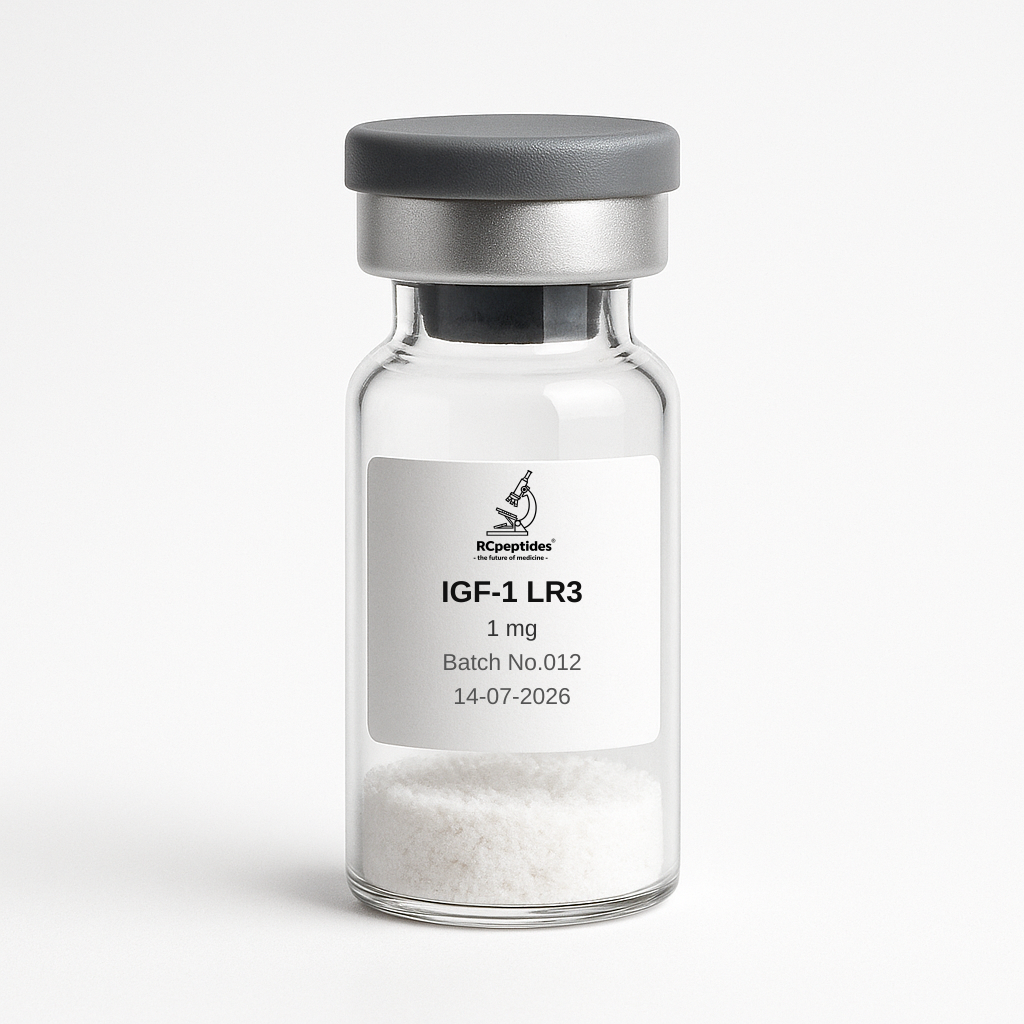
IGF1-LR3 1mg vial — IGF-1 LR3 is a modified analogue of human insulin-like growth factor-I. It has an arginine substitution at position 3 and an N-terminal extension. Its established research context includes cell-culture supplementation, where reduced interaction with IGF-binding proteins can affect the amount available to cells.
1. Compound and product overview
| Detail | Description |
|---|---|
| Compound | Long R3 insulin-like growth factor-I (IGF-1 LR3) |
| Class / target | Modified IGF-I analogue; IGF receptor signalling and reduced IGF-binding-protein interaction |
| Labelled presentation | IGF1-LR3 1mg vial |
| Research focus | Cell-culture supplementation, growth-factor responses and analytical measurement |
2. Mechanism and biological rationale
Native IGF-I and its analogues interact with growth-factor signalling systems. Binding proteins can influence the availability of IGF-I in culture. The LR3 modifications were developed to change those interactions; they do not establish a universal human half-life or a predictable muscle-growth response.
Cell-culture performance depends on the cell line, medium and concentration. A supplier’s reported comparison with insulin or native IGF-I applies to the conditions studied. It should not be converted into a fixed clinical potency ratio or a statement that every independently supplied IGF-1 LR3 product behaves identically.
3. Benefits and effects studied
The table describes endpoints investigated in the cited research. The evidence level and study setting matter: findings for a study compound or pharmaceutical formulation do not establish the same outcomes for this catalogue material.
| Research area | Findings and evidence limits |
|---|---|
| Culture performance | Manufacturer technical documentation describes use of LONG R3 IGF-I to support mammalian cell-culture growth, viability and productivity. Those are bioprocess endpoints, not human performance outcomes. |
| Binding-protein interaction | Reduced affinity for IGF-binding proteins provides a rationale for altered availability in culture. Availability and receptor activation should still be evaluated in the actual assay system. |
| Analytical quantification | Specific analytical methods are used to quantify the analogue in media and process samples. Measurement of mass and measurement of biological activity answer different questions. |
| Evidence boundaries | Cell-culture use does not establish safe self-administration, injury recovery, fat loss or a validated human exposure duration. No such outcome is established for this research vial. |
4. Evidence in context
The manufacturer references describe its own characterized LONG R3 material and technical applications. They provide background on the analogue, not a certificate for the product supplied in this listing. The 1mg catalogue presentation should be matched to its own batch documentation.
Protein adsorption to container surfaces, medium composition and degradation can affect the concentration actually available in an experiment. Distinguish nominal preparation concentration from a measured concentration and from a functional growth response. This avoids interpreting an unverified numerical potency claim as an intrinsic property of every preparation.
5. Product identity and laboratory considerations
Match the product name and labelled amount to the batch documentation before selecting a material for an experiment. Identity, purity and measured content answer different questions: a purity percentage alone does not establish the amount of the named compound, its biological activity, or the absence of every possible contaminant.
Use the original certificate where available to check the tested batch, analytical method and reported results. A result belongs to the sample and tests described in that report; it should not be extended to a different batch or treated as a clinical evaluation. Storage, solvent compatibility and stability after preparation require the documentation for the actual material and the conditions of the planned assay. A vial size is a product specification, not a treatment schedule.
6. Research scope
This listing supplies a research material. Published clinical studies use defined formulations, eligibility criteria, monitoring and analytical controls that are not established by this product listing. Laboratory observations, biomarkers and clinical outcomes should be interpreted separately. The cited literature provides background for scientific evaluation; it is not evidence that this particular product has been tested for therapeutic efficacy or safety.
Selected scientific references
For in vitro laboratory research use only. Not for human or veterinary use. Not intended for diagnosis, treatment or prevention of disease.
Price: €65.00
Collection: Peptides
Batch test results and COAs
Research use only. Not for human consumption.