Kisspeptin-10 10mg vial
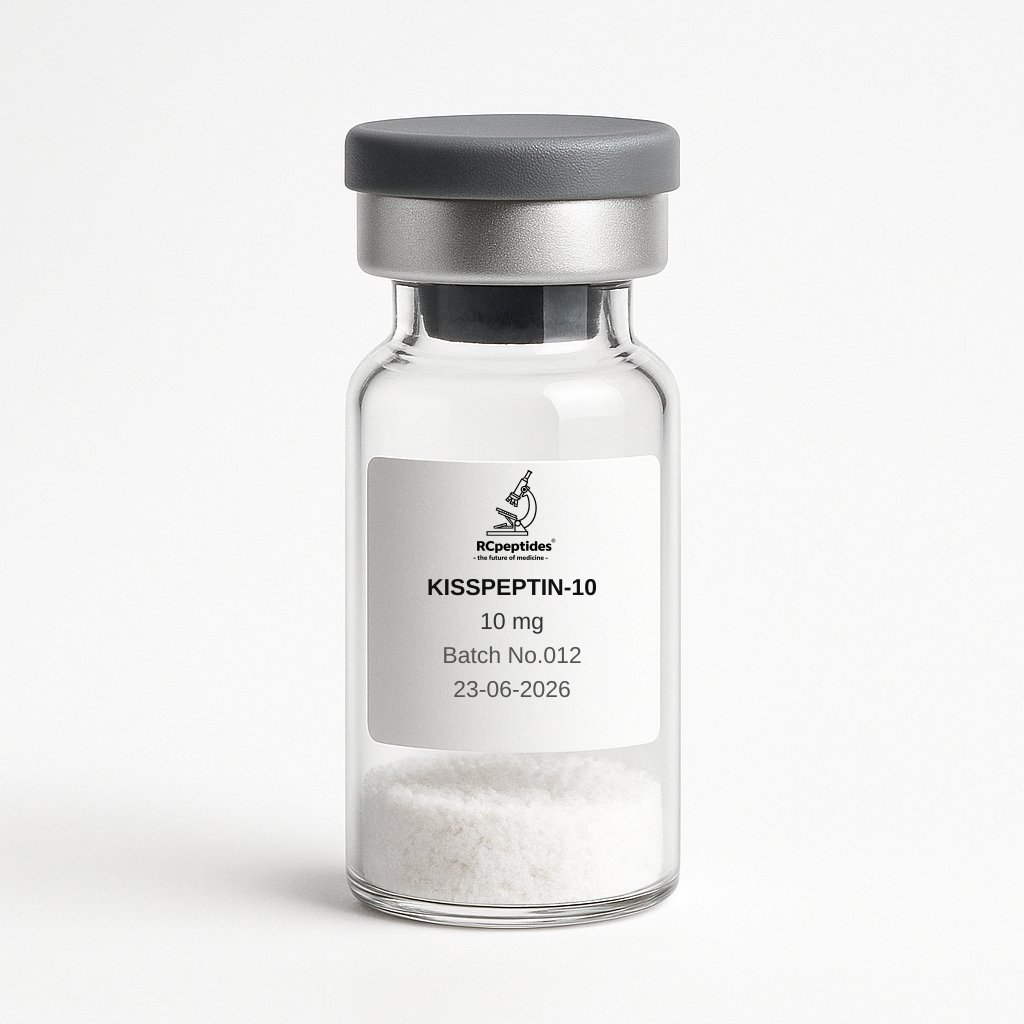
Kisspeptin-10 10mg vial — Kisspeptin-10 is a ten-amino-acid peptide from the kisspeptin family. It is studied for its ability to engage KISS1R and influence the reproductive hormone axis. The “10” identifies the peptide length and is separate from the labelled 10mg content of this vial.
1. Compound and product overview
| Detail | Description |
|---|---|
| Compound | Kisspeptin-10 |
| Class / target | KISS1 receptor (KISS1R; formerly GPR54) agonist peptide |
| Labelled presentation | Kisspeptin-10 10mg vial |
| Research focus | Hypothalamic–pituitary–gonadal signalling and reproductive endocrinology |
2. Mechanism and biological rationale
Kisspeptin signalling acts upstream of gonadotropin-releasing hormone pathways. It can influence luteinizing hormone secretion and related endocrine responses. This is different from directly replacing testosterone, LH or FSH, and it should not be described as a universally effective fertility or libido treatment.
Different kisspeptin forms share a biologically active region but differ in length and exposure characteristics. Kisspeptin-10 and kisspeptin-54 are not interchangeable product names. A clinical result obtained with kisspeptin-54 does not automatically establish the same outcome for a kisspeptin-10 research material.
3. Benefits and effects studied
The table describes endpoints investigated in the cited research. The evidence level and study setting matter: findings for a study compound or pharmaceutical formulation do not establish the same outcomes for this catalogue material.
| Research area | Findings and evidence limits |
|---|---|
| Luteinizing hormone response | A 2011 study in men reported that kisspeptin-10 stimulated LH secretion. This supports an endocrine mechanism; it is not a demonstration that this product treats infertility. |
| Hormone pulsatility | The same study assessed LH pulse frequency and testosterone responses under controlled experimental conditions. Hormone dynamics require appropriately timed sampling rather than a single unqualified “hormone boost” claim. |
| Reproductive-axis research | KISS1R signalling is relevant to investigation of reproductive endocrine regulation. Responses depend on the study population and endocrine context, so findings in healthy men cannot automatically be generalized to other groups. |
| Evidence boundaries | Sexual-behaviour, fertility-treatment and ovulation studies need their exact peptide form identified. No personal-use schedule, pre-intercourse protocol or guaranteed reproductive benefit follows from the cited kisspeptin-10 experiment. |
4. Evidence in context
The cited primary study is an endocrine investigation, with a defined peptide preparation and monitored hormone endpoints. Changes in LH or testosterone do not establish successful conception, improved sexual function or correction of a hormone disorder. Those would require their own controlled outcome studies.
Record peptide length, sequence and terminal modifications when matching a batch to the literature. A study using a different kisspeptin fragment may inform a general biological hypothesis while remaining an unsuitable basis for product-specific claims. The research question and selected readouts should preserve that distinction.
5. Product identity and laboratory considerations
Match the product name and labelled amount to the batch documentation before selecting a material for an experiment. Identity, purity and measured content answer different questions: a purity percentage alone does not establish the amount of the named compound, its biological activity, or the absence of every possible contaminant.
Use the original certificate where available to check the tested batch, analytical method and reported results. A result belongs to the sample and tests described in that report; it should not be extended to a different batch or treated as a clinical evaluation. Storage, solvent compatibility and stability after preparation require the documentation for the actual material and the conditions of the planned assay. A vial size is a product specification, not a treatment schedule.
6. Research scope
This listing supplies a research material. Published clinical studies use defined formulations, eligibility criteria, monitoring and analytical controls that are not established by this product listing. Laboratory observations, biomarkers and clinical outcomes should be interpreted separately. The cited literature provides background for scientific evaluation; it is not evidence that this particular product has been tested for therapeutic efficacy or safety.
Selected scientific references
For in vitro laboratory research use only. Not for human or veterinary use. Not intended for diagnosis, treatment or prevention of disease.
Price: €40.00
Collection: Gonadotropins
Batch test results and COAs
Research use only. Not for human consumption.