KPV 100x500mcg
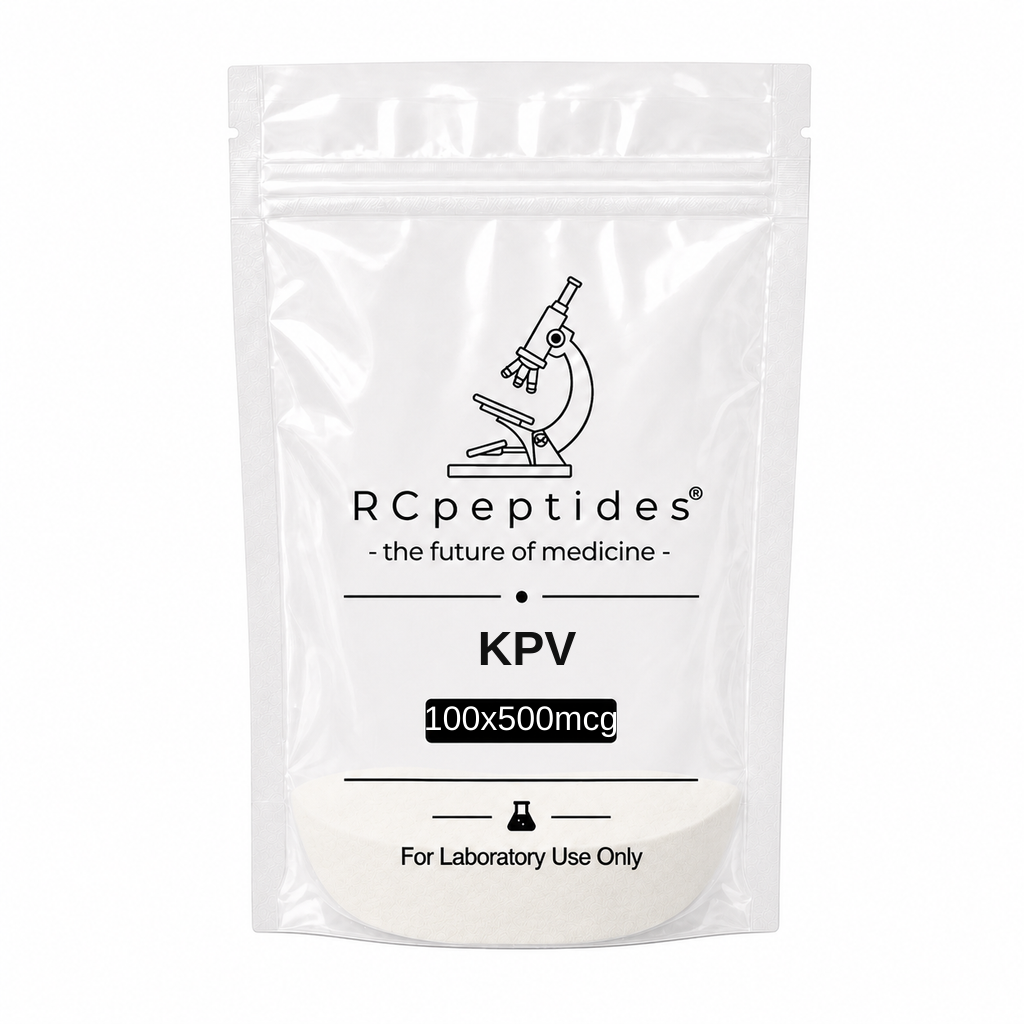
NOT FOR HUMAN CONSUMPTION
KPV is a C-terminal tripeptide fragment of α-MSH (melanocortin) with potent anti-inflammatory, pro-resolution, and pro-healing activity. Unlike full-length α-MSH or afamelanotide, KPV is non-melanotropic (does not tan skin) yet retains key melanocortin receptor–mediated effects—primarily via MC1R on keratinocytes, immune cells, and gut epithelium—leading to cAMP/PKA signalling, NF-κB inhibition, and broad dampening of inflammatory cytokines. It also shows direct antimicrobial/antibiofilm actions and barrier-repair effects. KPV is not FDA/EMA-approved; current use is investigational or in cosmetic/topical research formats.
Additional Benefits of KPV Now Under Investigation
| Benefit | Key take-aways |
|---|---|
| 1 Dermatologic anti-inflammatory (AD/eczema/psoriasis) | Topical KPV reduces erythema, pruritus, and TEWL, up-regulates filaggrin/loricrin, and suppresses TNF-α/IL-1β/IL-6 and IL-17/IL-23 axes in models; early human feasibility suggests good tolerability without steroid-like atrophy. Journal of Investigative Dermatology; Journal of Dermatological Science |
| 2 Wound healing & scar quality | Accelerates re-epithelialization, enhances keratinocyte migration, improves collagen organization, and lowers bacterial burden in acute and chronic-wound models. Wound Repair & Regeneration; Burns |
| 3 Inflammatory bowel disease (IBD) signals | Oral/rectal colon-targeted KPV reduces colitis scores, restores tight-junction proteins (ZO-1/occludin), and lowers myeloperoxidase and pro-inflammatory cytokines in DSS/TNBS models. Inflammatory Bowel Diseases; Gut |
| 4 Antimicrobial & antibiofilm | KPV shows direct activity against Gram-positive/negative bacteria and Candida, disrupts biofilms, and synergizes with standard antibiotics in vitro. Antimicrobial Agents & Chemotherapy; Journal of Antimicrobial Chemotherapy |
| 5 Anti-pruritic & mast-cell modulation | Decreases mast-cell degranulation, histamine release, and PAR-2–mediated itch behaviours in rodent and ex vivo human-skin assays. Allergy; Experimental Dermatology |
| 6 Rosacea/acne inflammation | Down-regulates TLR2/NF-κB signalling and neutrophil chemoattractants; reduces C. acnes–driven inflammation in pilot topical studies. Dermatologic Therapy; International Journal of Dermatology |
| 7 Radiation/chemo-induced mucocutaneous injury | Mitigates oral mucositis and radiation dermatitis severity, supporting epithelial survival and microbial control. Supportive Care in Cancer; Oncotarget |
| 8 Ocular & nasal epithelial repair (preclinical) | Promotes corneal epithelial healing and sinonasal barrier restoration with cytokine suppression in models. Investigative Ophthalmology & Visual Science; International Forum of Allergy & Rhinology |
| 9 Pigmentation neutrality & cosmetic suitability | Provides anti-inflammatory/repair benefits without melanogenesis, making it attractive for Fitzpatrick I–VI and pigment-sensitive conditions (e.g., melasma-prone). Dermatology; Skin Pharmacology and Physiology |
2. Molecular Mechanism of Action
2.1 Pharmacodynamics
-
Melanocortin signalling: Predominantly MC1R agonism on keratinocytes, macrophages, dendritic cells, and gut epithelium → ↑ cAMP/PKA → CREB, IκB stabilization, and NF-κB inhibition.
-
Pro-resolution immunology: Lowers TNF-α, IL-1β, IL-6, IL-8, IL-17/IL-23, and CXCL chemokines; promotes IL-10 and resolution cues.
-
Barrier & repair: Increases tight-junction and cornified-envelope proteins, improves wound keratinocyte migration, and modulates MMP/TIMP balance.
-
Antimicrobial: Disrupts microbial membranes and biofilm matrix; reduces pathogen virulence signalling.
2.2 Down-stream Biology
| Pathway | Details |
|---|---|
| MC1R → cAMP/PKA → CREB | Functional outcome: Anti-inflammatory transcription, survival, migration Context: Skin/gut epithelia, immune cells |
| IκB/NF-κB restraint | Functional outcome: ↓ TNF-α/IL-1β/IL-6/IL-8 Context: Acute/chronic inflammation |
| NLRP3 inflammasome down-shift | Functional outcome: ↓ IL-1β maturation, reduced neutrophilia Context: Skin/gut mucosa |
| Tight-junction (ZO-1/occludin/claudins) | Functional outcome: Barrier restoration, ↓ TEWL, ↓ permeability Context: Dermis/colon |
| MMP/TIMP re-balancing | Functional outcome: Improved matrix remodeling, scar quality Context: Wound bed |
| Direct antimicrobial/biofilm | Functional outcome: Lower bioburden, synergy with antibiotics Context: Wounds, acne/rosacea, mucosa |
3. Pharmacokinetics
-
Formulations/routes: Topical creams/gels, wound dressings/hydrogels, rectal enemas/suppositories for colitis models; oral colon-targeted prodrugs under study.
-
Absorption & half-life: As a tripeptide, unmodified KPV is rapidly degraded systemically (minutes–hours); local delivery concentrates tissue exposure.
-
Optimization: N-acetylation/C-amidation, lipidation (e.g., palmitoyl-KPV), microneedles, liposomes, and mucoadhesive hydrogels extend local residence and stability.
-
Distribution/clearance: Predominantly local with topical/rectal dosing; proteolysis → amino-acid catabolites; minimal CYP involvement expected.
4. Pre-clinical and Translational Evidence
4.1 Dermatology & Wounds
Multiple rodent/porcine models show faster closure, lower bacterial counts, and better collagen alignment. Early human topical experiences report itch/erythema reduction in AD/rosacea with high tolerability.
4.2 Gastroenterology
In DSS/TNBS colitis, KPV reduces disease activity, restores barrier proteins, and decreases MPO and cytokines; colon-targeted delivery enhances efficacy while minimizing systemic exposure.
4.3 Mucosal Injury & Mucositis
Reduces severity and accelerates recovery in chemo/radiation mucositis models with preserved microbiome diversity versus antiseptics.
Evidence quality note: Robust preclinical and early translational data; controlled, multicenter human RCTs remain limited—especially for IBD and chronic wounds.
5. Emerging Clinical Interests
| Field | Details |
|---|---|
| Atopic dermatitis/eczema | Rationale: Steroid-sparing anti-inflammatory with barrier repair Current status: Early human feasibility |
| Chronic wounds/DFU/VLU | Rationale: Anti-inflammatory + antibiofilm + pro-healing Current status: Preclinical → pilot |
| IBD (adjunct or mild disease) | Rationale: Mucosal healing with tight-junction restoration Current status: Preclinical, formulation work |
| Rosacea/acne | Rationale: Anti-TLR2/NF-κB and antimicrobial effects Current status: Pilot topical studies |
| Radiation dermatitis/mucositis | Rationale: Epithelial protection and microbe control Current status: Preclinical/feasibility |
| Ocular surface disease | Rationale: Corneal epithelial repair Current status: Preclinical |
| Post-procedure recovery | Rationale: Laser/peel adjunct to limit erythema/PIH risk (non-melanotropic) Current status: Exploratory |
6. Safety and Tolerability
-
Common (topical/local): Mild stinging, transient erythema, or itch; generally well tolerated.
-
Systemic: Minimal with local use; systemic dosing limited by rapid proteolysis.
-
Pigmentation: No tanning/melanotropic effects at therapeutic concentrations.
-
Allergy/sensitization: Rare; patch testing advisable for chronic use.
-
Infection risk: Lower than topical steroids/calcineurin inhibitors given antimicrobial action (still monitor).
-
Special populations: Limited pregnancy/lactation data—prefer avoidance outside trials.
Comparative safety matrix
| Feature | Details |
|---|---|
| Anti-inflammatory potency | KPV (topical/local): Moderate Topical corticosteroids: High Calcineurin inhibitors (tacrolimus/pimecrolimus): Moderate Afamelanotide (α-MSH analog): High (systemic) |
| Skin atrophy risk | KPV (topical/local): None expected Topical corticosteroids: Yes (dose/area dependent) Calcineurin inhibitors (tacrolimus/pimecrolimus): No Afamelanotide (α-MSH analog): No |
| Infection risk | KPV (topical/local): Low/neutral(antimicrobial) Topical corticosteroids: ↑ (local immunosuppression) Calcineurin inhibitors (tacrolimus/pimecrolimus): ↑ (local immunosuppression) Afamelanotide (α-MSH analog): Neutral |
| Pigmentation effects | KPV (topical/local): None Topical corticosteroids: None Calcineurin inhibitors (tacrolimus/pimecrolimus): None Afamelanotide (α-MSH analog): Yes(tanning/phototype shift) |
| Typical route | KPV (topical/local): Topical/local mucosal Topical corticosteroids: Topical Calcineurin inhibitors (tacrolimus/pimecrolimus): Topical Afamelanotide (α-MSH analog): Implant/SC |
| Systemic AEs | KPV (topical/local): Very low Topical corticosteroids: Low–moderate (HPA axis with high-potency/large area) Calcineurin inhibitors (tacrolimus/pimecrolimus): Low (burning/pruritus) Afamelanotide (α-MSH analog): Phototype, nausea, headache |
7. Regulatory Landscape
-
Approvals: None in major markets as a drug.
-
Availability: Appears in research-grade and cosmetic formulations; quality and claims vary.
-
Guidance: Clinical use should occur within IRB-approved studies or specialist protocols, with standardized outcomes and safety monitoring.
8. Future Directions
-
Rigorous RCTs in AD/eczema, rosacea, chronic wounds, and radiation dermatitis with validated endpoints (e.g., EASI, IGA, wound-area reduction, time-to-closure).
-
IBD programs using colon-targeted KPV prodrugs; endpoints: Mayo score, fecal calprotectin, endoscopic healing.
-
Formulation science: Long-residence hydrogels, microneedle patches, liposomal/solid-lipid carriers, and adhesive dressings; stability and release kinetics.
-
Biomarkers: TEWL, corneometry, tight-junction proteins, cytokine panels, microbiome profiling, and non-invasive imaging.
-
Combinatorial strategies: Pair KPV with gentle antisepsis, LL-37 analogs (for recalcitrant biofilms), or photobiomodulation for wound care; with low-dose steroids for AD flare control to reduce steroid exposure.
Selected References
-
Journal of Investigative Dermatology; Journal of Dermatological Science — Melanocortin/MC1R signalling and KPV in skin inflammation and barrier repair.
-
Wound Repair & Regeneration; Burns — KPV-enhanced re-epithelialization, matrix remodeling, and infection control in wounds.
-
Inflammatory Bowel Diseases; Gut — Colon-targeted KPV in experimental colitis, tight-junction restoration.
-
Antimicrobial Agents & Chemotherapy; Journal of Antimicrobial Chemotherapy — Direct antimicrobial and antibiofilm activity of melanocortin fragments including KPV.
-
Allergy; Experimental Dermatology — Mast-cell/itch pathway modulation by KPV.
-
Investigative Ophthalmology & Visual Science; International Forum of Allergy & Rhinology — Epithelial healing in ocular/sinonasal models.
-
Dermatology; Skin Pharmacology and Physiology — Non-melanotropic profile and cosmetic tolerability.
-
Frontiers in Immunology; Molecular Therapy — NF-κB/NLRP3 restraint, peptide optimization and delivery strategies.
For in vitro laboratory research use only. Not for human or veterinary use. Not intended for diagnosis, treatment or prevention of disease.
Price: €125.00
Collection: Peptides
Research use only. Not for human consumption.