NAD+ 1000mg vial
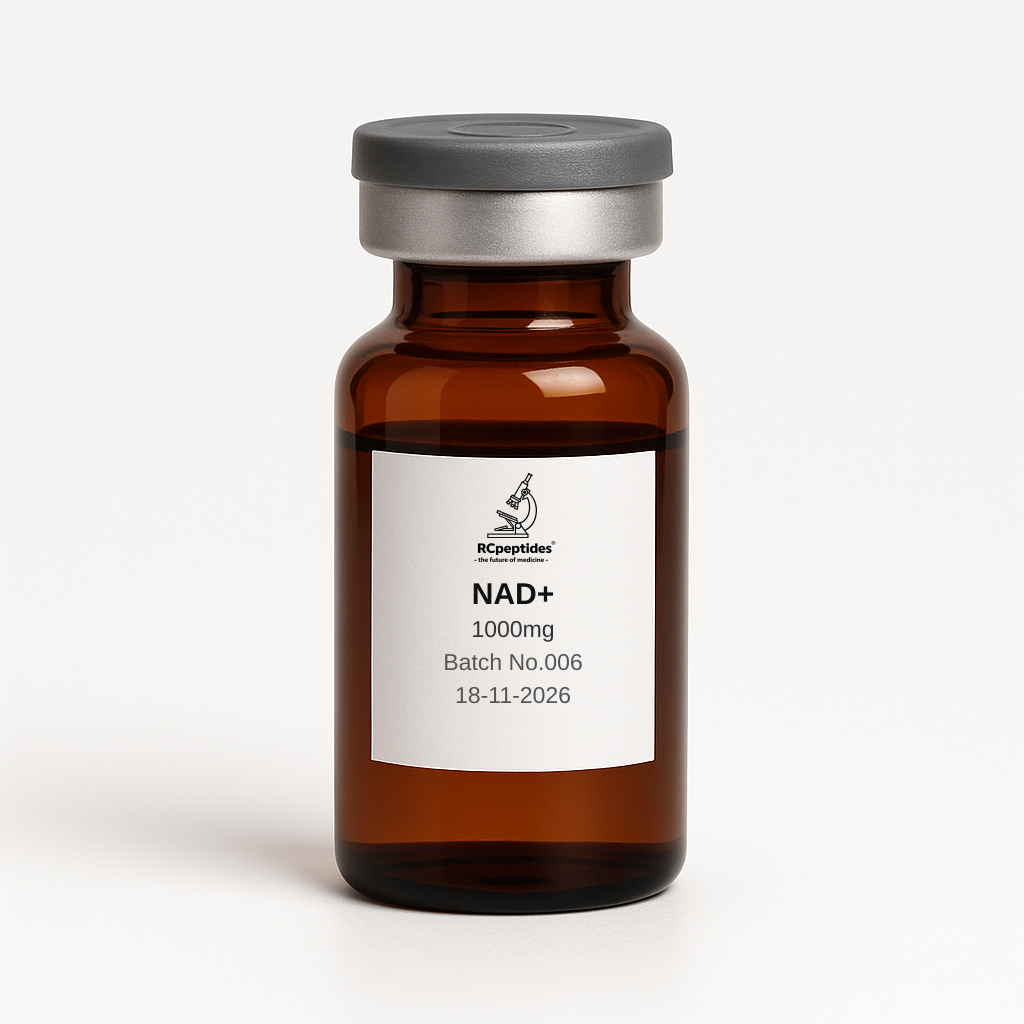
NAD+ 1000mg vial — NAD+ is the oxidized form of nicotinamide adenine dinucleotide, a coenzyme involved in cellular metabolism. It participates both in reversible redox reactions and in reactions that consume the molecule. This listing supplies the labelled vial quantity for laboratory research; NAD+ is chemically distinct from NADH and from precursors such as nicotinamide riboside or NMN.
1. Compound and product overview
| Detail | Description |
|---|---|
| Compound | Nicotinamide adenine dinucleotide, oxidized form (NAD+) |
| Class / target | Redox coenzyme and substrate for NAD-consuming enzymes; not a peptide |
| Labelled presentation | 1000mg vial |
| Research focus | Cellular metabolism, redox balance, compartmentalization and enzyme assays |
2. Mechanism and biological rationale
In redox reactions, NAD+ accepts reducing equivalents and is converted to NADH. The resulting NAD+/NADH balance is relevant to metabolic pathways and differs between cellular compartments. Measuring total NAD does not necessarily resolve oxidized versus reduced forms or reveal the amount present in mitochondria, cytosol or nucleus.
NAD+ also serves as a substrate for enzymes including sirtuins and poly(ADP-ribose) polymerases. These reactions have a different relationship to NAD availability from reversible redox cycling. An increase in an assay’s substrate concentration does not by itself demonstrate activation of every NAD-dependent pathway in an intact cell.
3. Benefits and effects studied
The table describes endpoints investigated in the cited research. The evidence level and study setting matter: findings for a study compound or pharmaceutical formulation do not establish the same outcomes for this catalogue material.
| Research area | Findings and evidence limits |
|---|---|
| Metabolic and redox measurements | NAD-dependent enzyme assays can examine oxidation–reduction reactions. Appropriate blanks and separation of NAD+ from NADH are necessary to avoid treating total coenzyme signal as a specific redox readout. |
| Mitochondrial compartmentalization | Primary research identified SLC25A51 as a mammalian mitochondrial NAD+ transporter. Altering that transporter changed mitochondrial NAD+ and respiration, supporting investigation of compartment-specific metabolism. |
| Extracellular metabolism | Cell-culture work shows that extracellular NAD+ can be degraded into other metabolites. Adding NAD+ to a culture medium does not automatically demonstrate direct uptake of intact NAD+ across the plasma membrane. |
| Translation to human outcomes | These biochemical findings do not establish rejuvenation, longer lifespan, improved athletic performance or a therapeutic benefit from the catalogue vial. Studies of NAD precursors cannot be treated as studies of this material. |
4. Evidence in context
NAD+ research spans purified enzymes, isolated organelles, cultured cells and whole organisms. Each setting exposes a different part of the biology. A transporter identified in the mitochondrial membrane does not settle how an extracellular compound enters a cell, and a change in total cellular NAD does not establish the same change in every compartment.
For an experiment, distinguish the chemical form, counterion or hydration state, concentration basis and analytical method. The nominal 500mg and 1000mg presentations refer to different quantities; neither states the final concentration of a prepared solution. Solvent volume, actual measured content and the material specification determine that calculation. The research category used by the shop does not change NAD+ into a peptide.
5. Product identity and laboratory considerations
Match the product name and labelled amount to the batch documentation before selecting a material for an experiment. Identity, purity and measured content answer different questions: a purity percentage alone does not establish the amount of the named compound, its biological activity, or the absence of every possible contaminant.
Use the original certificate where available to check the tested batch, analytical method and reported results. A result belongs to the sample and tests described in that report; it should not be extended to a different batch or treated as a clinical evaluation. Storage, solvent compatibility and stability after preparation require the documentation for the actual material and the conditions of the planned assay. A vial size is a product specification, not a treatment schedule.
6. Research scope
This listing supplies a research material. Published clinical studies use defined formulations, eligibility criteria, monitoring and analytical controls that are not established by this product listing. Laboratory observations, biomarkers and clinical outcomes should be interpreted separately. The cited literature provides background for scientific evaluation; it is not evidence that this particular product has been tested for therapeutic efficacy or safety.
Selected scientific references
- Luongo et al. — SLC25A51 is a mammalian mitochondrial NAD+ transporter (2020)
- Primary research on extracellular NAD+ degradation and cellular utilization
- Primary research on mitochondrial NAD+ transport and metabolism
For in vitro laboratory research use only. Not for human or veterinary use. Not intended for diagnosis, treatment or prevention of disease.
Price: €100.00
Collection: Peptides
Research use only. Not for human consumption.