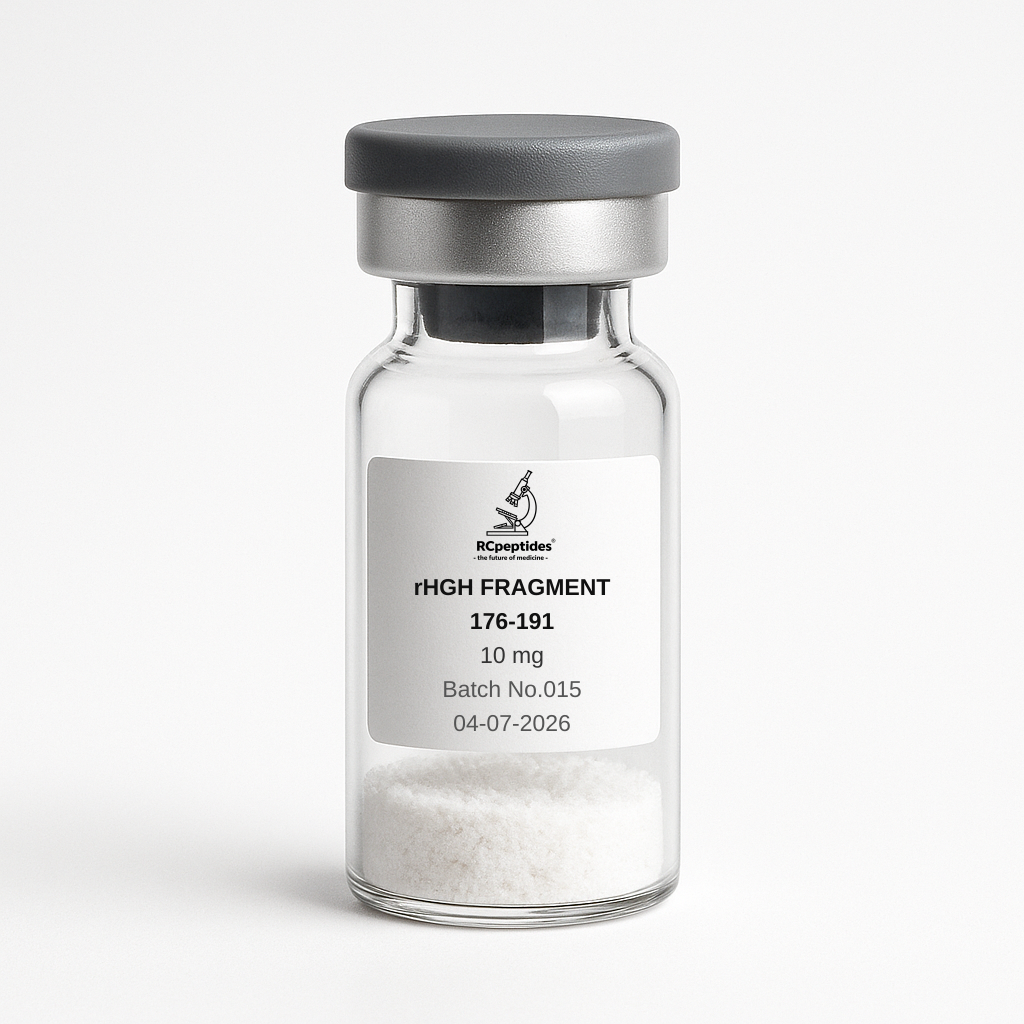
rHGH Fragment 176–191 10mg vial
NOT FOR HUMAN CONSUMPTION
rHGH Fragment 176–191 is a synthetic peptide corresponding to the C-terminus of human growth hormone. Unlike full-length GH, the 176–191 fragment does not activate the GH receptor or raise IGF-1. Preclinical work suggests adipocyte-selective actions—enhancing lipolysis and inhibiting lipogenesis—without classical GH-like anabolic or diabetogenic effects. It is not approved for any indication in major jurisdictions.
Additional Benefits of rHGH Fragment 176–191 Now Under Investigation
| Benefit | Key take-aways |
|---|---|
| 1 Selective adipose lipolysis | Rodent and cell studies show increased hormone-sensitive lipase activity and glycerol/FFA release in white adipocytes, with preferential reduction of abdominal/visceral fat versus lean tissue. Endocrinology; Peptides |
| 2 Anti-lipogenic effects | Downstream signalling reduces de novo lipogenesis markers (e.g., FAS/ACC) and can blunt LPL-mediated lipid uptake in adipose tissue. Metabolism; American Journal of Physiology |
| 3 Energy-expenditure signals | In diet-induced obese mice, treatment increases UCP-1/UCP-3 expression and fatty-acid oxidation genes, hinting at browning/thermogenic shifts. Molecular and Cellular Endocrinology; Obesity |
| 4 Glucose neutrality (short-term) | Small human studies report no meaningful change in fasting glucose or HbA1c over weeks; insulin and IGF-1 remain near baseline. Diabetes, Obesity and Metabolism |
| 5 No IGF-1 elevation | Because the fragment lacks GH-receptor activity, IGF-1 levels typically do not rise, potentially lowering mitogenic and edema risks seen with GH. Journal of Clinical Endocrinology & Metabolism |
| 6 Joint/tendon exploratory signal | Preclinical work shows increased collagen gene expression and improved histology after tendon injury; human data are insufficient. Journal of Orthopaedic Research; American Journal of Sports Medicine |
| 7 Liver-fat hypothesis | By reducing ectopic lipid flux from adipose tissue, models suggest downward pressure on hepatic steatosis; confirmatory human trials are lacking. Hepatology; Lipids in Health and Disease |
| 8 Lifestyle synergy | Pairing with caloric restriction and exercise amplifies fat-loss signals in animal models; human trials to date did not show large standalone weight loss. International Journal of Obesity |
| 9 Tolerability | Across short-term studies, AE rates near placebo (GI upset, headache most common); no consistent edema, arthralgia, or IGF-1-related effects. Long-term safety remains uncertain. Drug Safety; Clinical Therapeutics |
2. Molecular Mechanism of Action
2.1 Receptor Pharmacodynamics
The 176–191 fragment does not bind or activate the GH receptor and does not stimulate IGF-1. Proposed actions are adipocyte-selective, with evidence for cAMP/PKA-HSL pathway activation and suppression of lipogenic transcriptional programs. The precise upstream receptor remains unresolved.
2.2 Down-stream Biology
| Pathway | Details |
|---|---|
| cAMP–PKA–HSL | Functional outcome: ↑ lipolysis, FFA mobilization Context: White adipose tissue |
| AMPK/PPAR cross-talk | Functional outcome: ↑ fatty-acid oxidation, ↓ lipogenesis Context: Liver/adipose |
| Mitochondrial/thermogenic genes (UCPs) | Functional outcome: ↑ energy expenditure (preclinical) Context: Brown/brite adipocytes |
3. Pharmacokinetics
-
Absorption/route: Investigated as parenteral peptide; some programs explored oral formulations, but oral bioavailability appears low and formulation-dependent.
-
Half-life: Short plasma half-life (minutes to ~1 h) typical of small peptides; pharmacodynamic effects depend on frequent dosing or specialized delivery.
-
Distribution/Clearance: Primarily extracellular distribution; proteolytic degradation and renal clearance; no CYP interactions expected.
4. Pre-clinical and Translational Evidence
4.1 Obesity/Adiposity
Multiple rodent studies show reductions in fat mass and improvements in lipid oxidation with minimal effect on lean mass. Human RCTs have been mixed and several failed to meet primary weight-loss endpoints, though tolerabilitywas generally favorable.
4.2 Metabolic Health
Short-term human data show neutral glycaemia and no IGF-1 rise; lipid changes are modest and inconsistent. In animals, hepatic lipid handling and thermogenic gene expression improved.
4.3 Musculoskeletal Tissue
Exploratory preclinical data suggest collagen synthesis support and improved histology after tendon injury; clinical relevance is unproven.
5. Emerging Clinical Interests
| Field | Details |
|---|---|
| Adjunct in obesity care | Rationale: Adipocyte-selective lipolysis without IGF-1 Current status: Early human signals; no approvals |
| NAFLD/MASH (theoretical) | Rationale: Reduced adipose lipid spillover to liver Current status: Preclinical rationale; no pivotal trials |
| Sports-injury recovery | Rationale: Collagen gene up-regulation in models Current status: Preclinical only |
| Cardiometabolic risk | Rationale: Possible TG/HDL improvements if fat mass drops Current status: Requires robust human data |
6. Safety and Tolerability
-
Common AEs: Mild GI discomfort, headache, injection-site reactions (parenteral).
-
Endocrine: IGF-1 unchanged; no GH-like edema/arthralgia pattern reported in short studies.
-
Glycaemia: Generally neutral; no systematic hypoglycaemia signal.
-
Unknowns: Long-term safety, carcinogenicity, and effects in special populations remain insufficiently characterized.
Comparative safety matrix
| Concern | Details |
|---|---|
| IGF-1 elevation | rHGH 176–191 fragment: No Tesamorelin (GHRH analog): Yes (physiologic) Somatropin (GH): Yes (dose-dependent) |
| Edema/arthralgia | rHGH 176–191 fragment: Low (short-term) Tesamorelin (GHRH analog): Moderate Somatropin (GH): Moderate–higher |
| Glycaemic impact | rHGH 176–191 fragment: Neutral (short-term) Tesamorelin (GHRH analog): Neutral → mild ↑ Somatropin (GH): Neutral → mild ↑ |
| Evidence for fat loss | rHGH 176–191 fragment: Preclinical > human Tesamorelin (GHRH analog): Robust in HIV VAT Somatropin (GH): Mixed in non-GHD adults |
7. Regulatory Landscape
-
Approval status: Not approved by FDA/EMA or other major regulators for any indication.
-
Sporting bodies: Classified under non-approved substances by anti-doping authorities; use in sport is prohibited.
-
Supply: Frequently marketed online as a “research chemical”; quality, purity, and dosing not assured.
8. Future Directions
-
Mechanistic clarity: Identify the proximal receptor/target and confirm on-target biomarkers in humans.
-
PK engineering: Half-life extension (e.g., lipidation, depot, or pegylation) to enable practical dosing.
-
Phenotype targeting: Trials in visceral-predominant obesity or NAFLD with imaging (MRI-PDFF) and metabolic endpoints.
-
Combination therapy: Pairing with GLP-1/GIP agonists or SGLT2 inhibitors to evaluate additive fat- and liver-fat reductions.
Selected References
-
Endocrinology; Peptides; Metabolism; American Journal of Physiology — preclinical studies of hGH C-terminal fragments (176–191) on adipocyte lipolysis and lipogenesis.
-
Obesity; Diabetes, Obesity and Metabolism; Clinical Therapeutics — human tolerability and efficacy signals; several trials with limited weight-loss outcomes.
-
Journal of Orthopaedic Research; American Journal of Sports Medicine — exploratory musculoskeletal/tendon biology with GH-fragment peptides.
-
Drug Safety — short-term safety summaries for peptide-based anti-obesity candidates.
-
World Anti-Doping Code/Prohibited List — classification of non-approved peptide hormones and related substance
For in vitro laboratory research use only. Not for human or veterinary use. Not intended for diagnosis, treatment or prevention of disease.
Price: €50.00
Collection: Peptides
Batch test results and COAs
Research use only. Not for human consumption.