Sermorelin 10mg vial
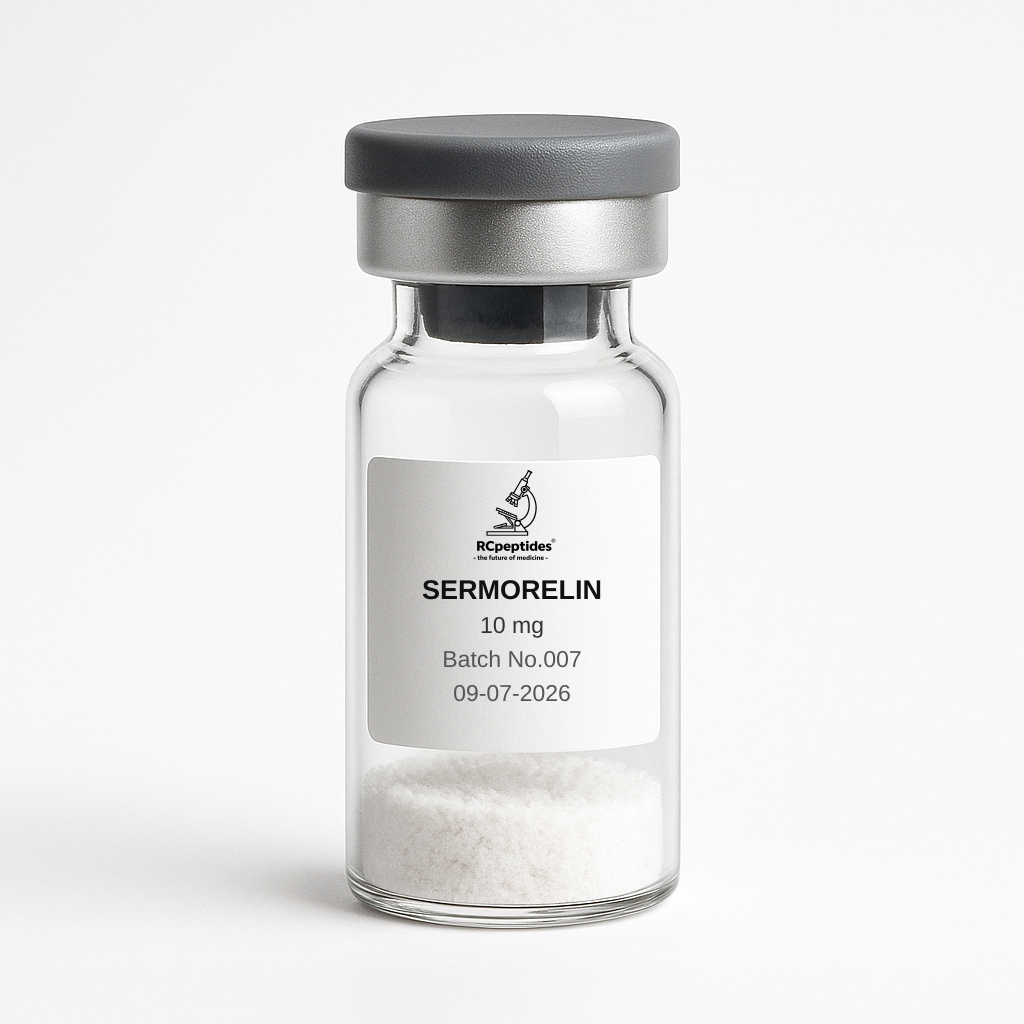
NOT FOR HUMAN CONSUMPTION
Sermorelin is a synthetic growth-hormone–releasing hormone (GHRH 1–29) analog that binds pituitary GHRH receptors (GHRHR) to provoke physiologic, pulsatile GH release and downstream increases in IGF-1. In the U.S., sermorelin was previously marketed as Geref®/Geref Diagnostic® for evaluating pituitary GH reserve; it is not FDA-approved for chronic treatment of growth disorders or obesity and branded drug was discontinued for non-safety/commercial reasons. Compounded products are used off-label in some settings.
Additional Benefits of Sermorelin Now Under Investigation
| Benefit | Key take-aways |
|---|---|
| 1 Physiologic GH restoration vs exogenous GH | Sermorelin elicits endogenous, pulsatile GH with intact hypothalamic feedback (somatostatin/IGF-1), typically raising IGF-1 into—rather than above—the age-adjusted normal range. Endocrine Reviews; Journal of Clinical Endocrinology & Metabolism |
| 2 Diagnostic utility for GH axis | As a GHRH stimulation test (often 1 µg/kg IV), sermorelin helps differentiate hypothalamic vs pituitary deficits and can increase diagnostic sensitivity when combined with arginine or clonidine. JCEM; Pediatrics |
| 3 Sleep architecture & SWS support | GHRH analogs including sermorelin augment slow-wave sleep and nighttime GH pulsatility, especially in midlife adults with blunted SWS. Sleep; Neuroendocrinology |
| 4 Body-composition signals | Small open-label series report modest VAT reduction and fat-free mass preservation under nightly SC dosing, consistent with GH physiology; effects are smaller than with tesamorelin or GH. Metabolism; Hormone Research in Paediatrics |
| 5 Bone turnover | Short-term increases in bone-formation markers (P1NP, osteocalcin) via GH→IGF-1 pathways; long-term fracture data are lacking. Bone; Osteoporosis International |
| 6 Exercise recovery & collagen synthesis | By restoring nocturnal GH pulses, sermorelin may support tendon/ligament collagen synthesisand recovery, though high-quality RCTs are limited. American Journal of Physiology; Sports Medicine |
| 7 Cognitive/affective domains | In older adults, GHRH analog regimens improved executive function and memory in small trials; sermorelin is mechanistically similar but direct sermorelin RCTs are sparse. Archives of Neurology; JAMA Neurology |
| 8 Cardiometabolic markers | Responders may show lower triglycerides and higher adiponectin in parallel with IGF-1 normalization; glucose impact is neutral to mildly adverse and requires monitoring. Diabetes Care; Journal of Clinical Lipidology |
| 9 Pediatric transition scenarios | As a physiologic secretagogue, sermorelin has been explored for borderline/functional GHD and transition-age assessment, but somatropin remains standard therapy. Pediatrics; European Journal of Endocrinology |
2. Molecular Mechanism of Action
2.1 Receptor Pharmacodynamics
Sermorelin binds GHRHR on pituitary somatotrophs → Gs–adenylate cyclase–cAMP–PKA–CREB activation → GH pulse generation. Peripheral GH acts via GHR–JAK2–STAT5, increasing hepatic IGF-1 and lipolytic enzymes; somatostatin and IGF-1 furnish negative feedback, preserving physiologic rhythm.
2.2 Down-stream Biology
| Pathway | Details |
|---|---|
| JAK2–STAT5 (GH) | Functional outcome: ↑ IGF-1, ↑ lipolysis, ↓ de novo lipogenesis Context: Liver, adipose |
| PI3K–Akt–mTOR (IGF-1) | Functional outcome: ↑ protein synthesis, ↑ fat-free mass Context: Skeletal muscle |
| CNS sleep network (GHRH) | Functional outcome: ↑ slow-wave sleep, nocturnal GH pulses Context: Hypothalamus/cortex |
3. Pharmacokinetics
-
Absorption: Rapid after SC; diagnostic use often IV.
-
Half-life: ~10–20 min (short), necessitating bedtime or repeat dosing for therapeutic aims.
-
Distribution: Acts primarily at pituitary; systemic effects mediated via GH/IGF-1.
-
Clearance: Proteolytic degradation; no CYP interactions expected.
4. Pre-clinical and Translational Evidence
4.1 Adult & Pediatric GH Axis
Sermorelin reliably increases GH/IGF-1 in subjects with intact somatotrophs; blunted/absent responses suggest pituitary disease. Pediatric evaluation shows good tolerability and diagnostic yield in conjunction with other stimuli.
4.2 Sleep & Neurocognition
GHRH-based paradigms improve slow-wave sleep and may enhance executive function in aging cohorts; direct sermorelin data are limited but mechanistically aligned.
4.3 Body Composition / Metabolism
Exploratory studies indicate modest VAT reductions and lipid improvements with nightly SC administration; effects regress after discontinuation, consistent with GH physiology.
5. Emerging Clinical Interests
| Field | Details |
|---|---|
| Diagnostic endocrinology | Rationale: Differentiate hypothalamic vs pituitary GH defects Current status: Established methodology, less common since widespread IGF-1/ITTs |
| Sarcopenic obesity/aging | Rationale: Physiologic GH restoration with feedback control Current status: Pilot/open-label studies; no pivotal trials |
| Neurocognitive aging | Rationale: GHRH→GH→IGF-1 neurotrophic pathways Current status: Small RCT signals with GHRH analogs |
| Sleep medicine | Rationale: Augment SWS in midlife adults with low GH Current status: Proof-of-concept data; more trials needed |
6. Safety and Tolerability
-
Common: Transient flushing, warmth, nausea, headache, mild injection-site reactions.
-
Endocrine: IGF-1 rise—monitor to keep within age-normal range; glucose can drift upward in susceptible patients.
-
Contraindications/Cautions: Active malignancy, pregnancy, hypersensitivity. Use caution in severe OSA, diabetic retinopathy, or intracranial hypertension risk.
-
Abuse potential: Off-label/compounded use exists; safety beyond short-term diagnostic dosing is less well characterized than for tesamorelin or GH.
Comparative safety matrix
| Concern | Details |
|---|---|
| GH dynamics | Sermorelin (GHRH 1–29): Physiologic pulses Tesamorelin (stabilized GHRH analog): Physiologic-like pulses Somatropin (GH): Non-physiologic exposure |
| IGF-1 control | Sermorelin (GHRH 1–29): Feedback-limited Tesamorelin (stabilized GHRH analog): Feedback-limited Somatropin (GH): Directly dose-driven |
| Edema/arthralgia | Sermorelin (GHRH 1–29): Low–moderate Tesamorelin (stabilized GHRH analog): Moderate Somatropin (GH): Moderate–higher |
| Glucose impact | Sermorelin (GHRH 1–29): Neutral → mild ↑ Tesamorelin (stabilized GHRH analog): Neutral → mild ↑ Somatropin (GH): Neutral → mild ↑ |
| Evidence base for VAT | Sermorelin (GHRH 1–29): Limited/exploratory Tesamorelin (stabilized GHRH analog): Robust RCTs Somatropin (GH): Mixed in non-GHD adults |
7. Regulatory Landscape
-
U.S. status: Prior approval for diagnostic evaluation of pituitary GH reserve (Geref/Geref Diagnostic); commercial product discontinued.
-
Treatment approvals: None for chronic therapy of GHD, obesity, or anti-aging.
-
Guidance: Professional societies recommend somatropin for confirmed GHD; tesamorelin for HIV-associated lipodystrophy. Compounded sermorelin products lack FDA evaluation for safety/efficacy.
8. Future Directions
-
Long-acting GHRH analogs or delivery systems (e.g., depot/intranasal) to overcome the short half-life.
-
Head-to-head trials versus GH or tesamorelin in sarcopenic obesity and NAFLD phenotypes.
-
Biomarker-guided dosing using IGF-1 SDS and sleep metrics (SWS) to personalize benefit while minimizing glycaemic drift.
-
Neurocognitive studies in aging/MCI cohorts to test class effects on memory networks.
Selected References
-
Thorner MO, Merriam GR, et al. Physiology and pharmacology of GHRH and secretagogues. Endocrine Reviews.
-
Geref®/Geref Diagnostic® U.S. Prescribing Information (archival): Sermorelin acetate for GH stimulation testing.
-
Ho KY, et al. GH pulse generation by GHRH in adults; feedback regulation by somatostatin/IGF-1. JCEM.
-
Van Cauter E, Born J. GHRH, slow-wave sleep, and GH secretion across aging. Sleep; Neuroendocrinology.
-
Baker LD, et al. GHRH analog improves cognition in healthy older adults and MCI. Arch Neurol; JAMA Neurol.
-
Rudman D, et al. Body-composition responses to GH-axis modulation in aging. Metabolism.
-
Giustina A, et al. Guidelines for adult GHD diagnosis/treatment. European Journal of Endocrinology.
-
Engelson ES, Stanley TL, et al. VAT, lipids, adipokines under GH-axis manipulation. JCEM; Journal of Clinical Lipidology.
-
Pediatric Endocrine Society statements on stimulation testing and transition care.
For in vitro laboratory research use only. Not for human or veterinary use. Not intended for diagnosis, treatment or prevention of disease.
Price: €60.00
Collection: GH Analogs and Secretagogues
Batch test results and COAs
Research use only. Not for human consumption.