Survodutide 10mg vial
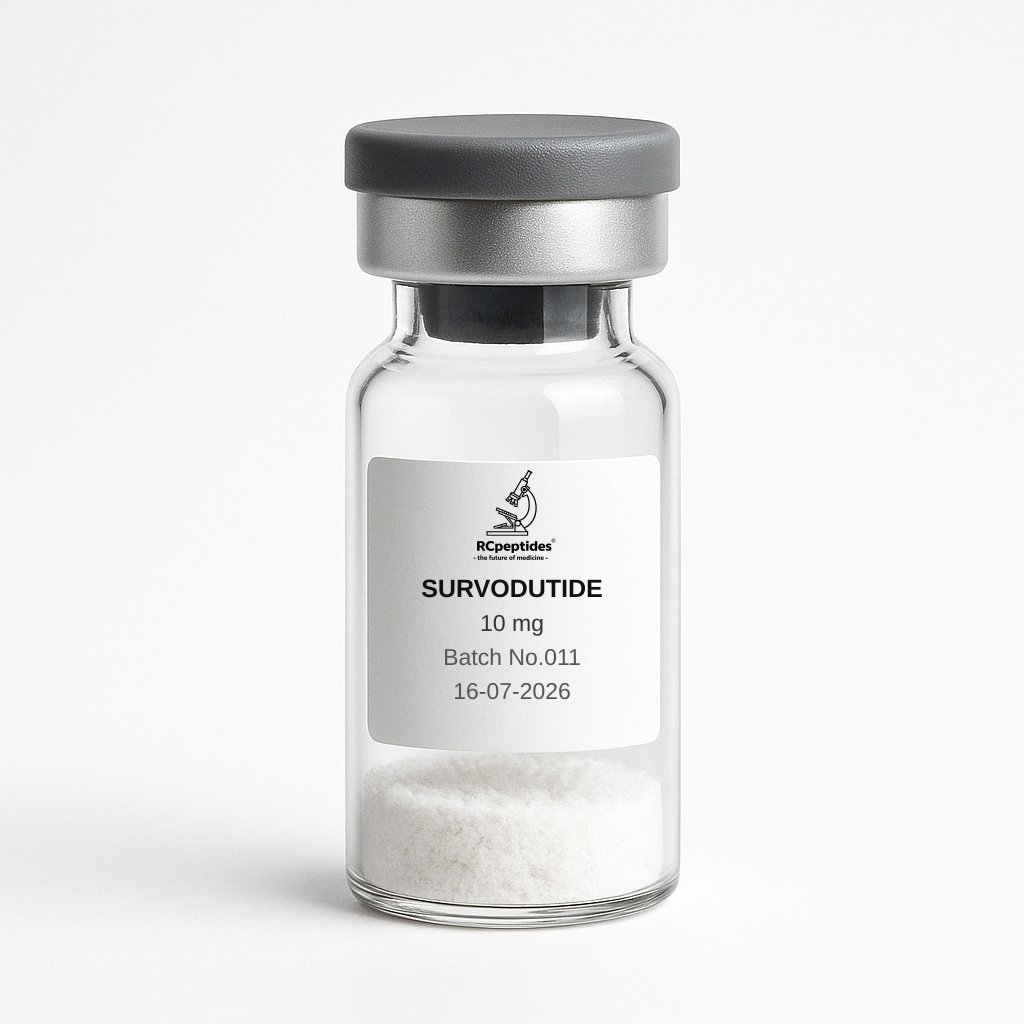
Survodutide 10mg vial — Survodutide is a dual glucagon/GLP-1 receptor agonist investigated in metabolic research. Its two receptor activities distinguish it from GLP-1-only compounds and from the GIP/GLP-1/glucagon triple agonist retatrutide. This listing is the labelled 10mg research vial.
1. Compound and product overview
| Detail | Description |
|---|---|
| Compound | Survodutide (BI 456906) |
| Class / target | Dual glucagon and GLP-1 receptor agonist peptide |
| Labelled presentation | Survodutide 10mg vial |
| Research focus | Metabolic signalling, obesity endpoints and metabolic liver-disease research |
2. Mechanism and biological rationale
The GLP-1 component is relevant to nutrient-dependent glucose regulation and appetite signalling, while glucagon receptor activity contributes a complementary hepatic metabolic pathway. The development rationale is to examine whether these combined actions can influence body weight and metabolic liver disease. The presence of glucagon activity does not independently prove a clinically meaningful increase in energy expenditure in every setting.
For laboratory evaluation, receptor selectivity, downstream signalling and concentration-dependent responses should be assessed in defined systems. Weight change, MRI liver fat and histological liver endpoints are separate measurements. A favourable result for one does not automatically establish another, and findings in patients with diabetes cannot be assumed to match those in participants without diabetes.
3. Benefits and effects studied
The table describes endpoints investigated in the cited research. The evidence level and study setting matter: findings for a study compound or pharmaceutical formulation do not establish the same outcomes for this catalogue material.
| Research area | Findings and evidence limits |
|---|---|
| Body-weight endpoints without diabetes | The 76-week phase 3 SYNCHRONIZE-1 publication reported mean weight changes of −12.2% and −13.0% in the two survodutide groups versus −5.4% with placebo under the treatment-regimen estimand. |
| Body-weight endpoints with type 2 diabetes | SYNCHRONIZE-2 reported 76-week changes of −8.2% and −9.8% versus −3.9% with placebo under its treatment-regimen analysis. Different study populations explain why these results need their own context. |
| MASH histology | In a 48-week phase 2 trial with 293 participants, improvement in MASH without worsening fibrosis occurred in 47%, 62% and 43% of the survodutide groups versus 14% with placebo. This endpoint is not equivalent to complete fibrosis reversal. |
| Liver fat and tolerability | The MASH study also assessed MRI liver fat and fibrosis-stage changes. Gastrointestinal events were more frequent with treatment; efficacy findings should be read alongside the study’s adverse-event and discontinuation results. |
4. Evidence in context
The cited phase 3 obesity studies and phase 2 MASH study support investigation of different clinical questions. MASH refers to metabolic dysfunction-associated steatohepatitis; it should not be used interchangeably with an isolated increase in liver fat. Histological outcomes require biopsy-based definitions, whereas MRI measures the amount of fat in the liver.
Trial percentages are population averages with defined inclusion criteria and statistical assumptions. Treatment-regimen and efficacy analyses can produce different numbers even within the same trial. No comparison in this description is a head-to-head claim against another catalogue product. Likewise, a reduction in body weight or liver fat is not evidence that this research material prevents cardiovascular events or treats a specific individual.
5. Product identity and laboratory considerations
Match the product name and labelled amount to the batch documentation before selecting a material for an experiment. Identity, purity and measured content answer different questions: a purity percentage alone does not establish the amount of the named compound, its biological activity, or the absence of every possible contaminant.
Use the original certificate where available to check the tested batch, analytical method and reported results. A result belongs to the sample and tests described in that report; it should not be extended to a different batch or treated as a clinical evaluation. Storage, solvent compatibility and stability after preparation require the documentation for the actual material and the conditions of the planned assay. A vial size is a product specification, not a treatment schedule.
6. Research scope
This listing supplies a research material. Published clinical studies use defined formulations, eligibility criteria, monitoring and analytical controls that are not established by this product listing. Laboratory observations, biomarkers and clinical outcomes should be interpreted separately. The cited literature provides background for scientific evaluation; it is not evidence that this particular product has been tested for therapeutic efficacy or safety.
Selected scientific references
- SYNCHRONIZE-1 — Survodutide in obesity (2026)
- SYNCHRONIZE-2 — Survodutide in obesity and type 2 diabetes (2026)
- Sanyal et al. — Survodutide in MASH, phase 2 (2024)
For in vitro laboratory research use only. Not for human or veterinary use. Not intended for diagnosis, treatment or prevention of disease.
Price: €90.00
Collection: Peptides
Batch test results and COAs
Research use only. Not for human consumption.