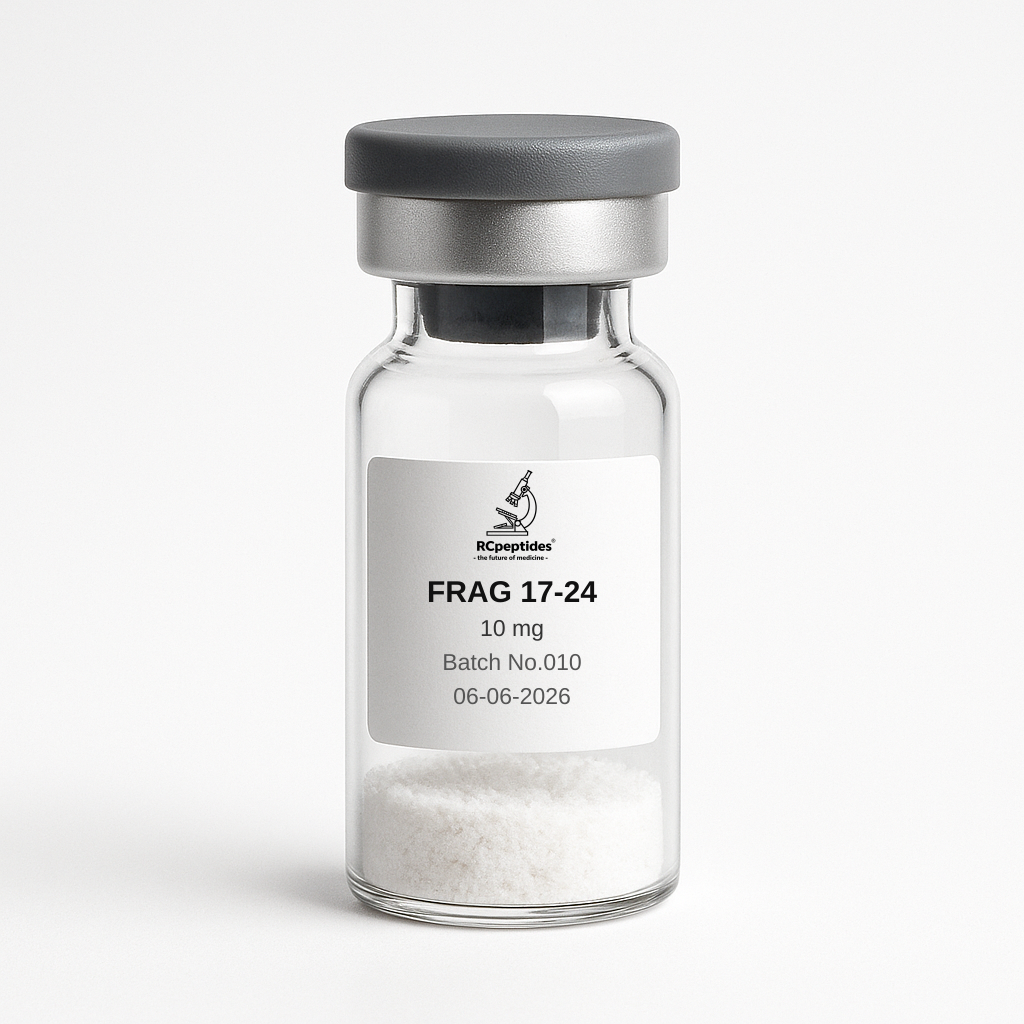
Thymosin β4 Fragment 17–24 10mg vial
NOT FOR HUMAN CONSUMPTION
"Frag 17–24" refers to the actin-binding core motif of thymosin β4 (Tβ4)—the octa/heptapeptide sequence around residues 17–24 (canonical: LKKTETQE / 17–23 LKKTETQ). This short fragment retains key cell-migration and cytoskeletal activities attributed to full-length Tβ4 and is used in research under the colloquial name TB-500 (a Tβ4-derived fragment). It is explored for wound repair, tendon/ligament recovery, angiogenesis, and anti-inflammatory remodeling. No product in this class is FDA/EMA-approved.
Additional Benefits of Tβ4 Frag 17–24 (TB-500-class) Now Under Investigation
| Benefit | Key take-aways |
|---|---|
| 1 Accelerated wound closure & re-epithelialization | Fragment promotes keratinocyte migration, lamellipodia formation, and granulation tissue; topical or perilesional dosing shortens time-to-closure in animal cutaneous wounds. Wound Repair & Regeneration; Journal of Investigative Dermatology |
| 2 Angiogenesis & perfusion restoration | Up-regulates VEGF, HIF-1α, and endothelial outgrowth, improving microvascular density in ischemic tissue models. Circulation Research; Angiogenesis |
| 3 Tendon/ligament healing | Enhances tenocyte migration, collagen I/III alignment, and mechanical strength post-injury; synergy reported with eccentric-loading rehab. American Journal of Sports Medicine; Journal of Orthopaedic Research |
| 4 Anti-inflammatory remodeling | Dampens NF-κB/TNF-α/IL-1β and shifts macrophages toward pro-resolving phenotypes, reducing edema and scar thickness. Journal of Immunology; Inflammation Research |
| 5 Cardioprotection (preclinical) | In myocardial I/R and chronic ischemia models, Tβ4-motif peptides reduce apoptosis, enhance Akt/ILK signalling, and limit fibrosis—improving function. Circulation; Cardiovascular Research |
| 6 Corneal/ocular surface repair | Speeds corneal epithelial healing and nerve regeneration with improved tear-film metrics in dry-eye/keratitis models. Investigative Ophthalmology & Visual Science; Cornea |
| 7 Skeletal muscle regeneration | Augments satellite-cell migration, myotube formation, and vascular support after contusion/strain. FASEB Journal; Muscle & Nerve |
| 8 Anti-fibrotic signaling | Lowers TGF-β/CTGF and disordered collagen deposition in skin and tendon, yielding more elastic scars. Matrix Biology; Fibrogenesis & Tissue Repair |
| 9 Hair-follicle cycling (exploratory) | Tβ4-derived sequences can activate anagen, increase VEGF around follicles, and improve shaft calibre in murine models. Experimental Dermatology; Dermatologic Therapy |
2. Molecular Mechanism of Action
2.1 Receptor/Target Pharmacodynamics
The LKKTETQ(E) motif binds G-actin, modulating actin sequestration and polymerization. Downstream, it engages integrin-linked kinase (ILK) and PI3K–Akt, influences focal-adhesion dynamics (FAK/vinculin), and induces MMP-2/9 for controlled matrix remodeling. Indirect effects include VEGF/HIF-1α induction and NF-κB tempering in inflamed tissue.
2.2 Down-stream Biology
| Pathway | Details |
|---|---|
| Actin–ILK–Akt | Functional outcome: Cell migration, survival, cytoskeletal repair Context: Keratinocytes, tenocytes, endothelium |
| FAK/MMP program | Functional outcome: Matrix remodeling, sprouting angiogenesis Context: Wound bed, tendon/ligament |
| HIF-1α → VEGF | Functional outcome: Neovascularization, improved perfusion Context: Ischemic tissue, cornea |
| NF-κB down-tuning | Functional outcome: ↓ TNF-α/IL-1β, pro-resolving macrophages Context: Inflamed wounds, tendon sheath |
| TGF-β/CTGF restraint | Functional outcome: ↓ pathologic fibrosis, better collagen alignment Context: Scar/Tendon matrix |
3. Pharmacokinetics
-
Route/formulations: Investigated subcutaneous/perilesional injections, topical gels/eye drops, and biomaterial dressings.
-
Half-life: Short (minutes–hours); biological effects persist via transcriptional and matrix changes.
-
Distribution: Predominantly local; systemic exposure limited unless high/IV doses used.
-
Clearance: Peptidase degradation; no CYP interactions expected.
4. Pre-clinical and Translational Evidence
4.1 Cutaneous & Soft-tissue Repair
Multiple rodent and porcine models show faster closure, improved tensile strength, and reduced scar with fragment dosing vs control, paralleling full-length Tβ4.
4.2 Musculoskeletal
In tendon laceration/overuse models, fragment treatment improved collagen fibre orientation and load-to-failure; functional recovery was enhanced when combined with graded loading.
4.3 Ocular Surface
Topical derivatives accelerated corneal re-epithelialization, decreased pain/staining, and supported subbasal nerveregrowth.
Evidence quality note: Most data are pre-clinical or early clinical/ophthalmic pilot; standardized, placebo-controlled human trials for musculoskeletal uses remain limited.
5. Emerging Clinical Interests
| Field | Details |
|---|---|
| Chronic wounds (DFU/VLU) | Rationale: Pro-migration + antibiofilm-friendly remodeling Current status: Early clinical/feasibility |
| Tendon/ligament rehab | Rationale: Faster matrix repair with better alignment Current status: Pre-clinical → small series |
| Corneal disease/dry eye | Rationale: Epithelial/nerve repair Current status: Early ophthalmic pilots |
| Cardiac ischemia | Rationale: Cytoprotection + microvascular support Current status: Pre-clinical |
| Scar modulation | Rationale: Anti-fibrotic remodelling Current status: Pre-clinical/observational |
6. Safety and Tolerability
-
Common (local): Mild injection-site irritation or stinging with topicals; transient erythema.
-
Systemic: Limited data; short peptides generally well tolerated in animals at research doses.
-
Theoretical cautions: Pro-angiogenic activity may be undesirable in active malignancy or proliferative retinopathies; monitor for exuberant granulation in high-dose topical use.
-
Quality/purity: Grey-market products vary; prefer GMP-grade materials in research.
Comparative safety matrix
| Concern | Details |
|---|---|
| Size/PK | Tβ4 Frag 17–24 (TB-500-class): Short; very rapid clearance Full-length Tβ4 (43 aa): Longer; still short-lived BPC-157: Short; GI stability claims (preclinical) |
| Angiogenesis | Tβ4 Frag 17–24 (TB-500-class): Yes (VEGF/HIF-1α) Full-length Tβ4 (43 aa): Yes (often stronger) BPC-157: Context-dependent |
| Tendon/ligament data | Tβ4 Frag 17–24 (TB-500-class): Good preclinical Full-length Tβ4 (43 aa): Robust preclinical BPC-157: Good preclinical |
| Human evidence | Tβ4 Frag 17–24 (TB-500-class): Sparse/early Full-length Tβ4 (43 aa): Early ophthalmic/derm pilots BPC-157: Sparse/heterogeneous |
| Regulatory status | Tβ4 Frag 17–24 (TB-500-class): Not approved Full-length Tβ4 (43 aa): Not approved BPC-157: Not approved |
7. Regulatory Landscape
-
Approvals: None in major markets.
-
Access: Research/compounded channels; WADA generally prohibits non-approved growth-repair peptides under S0.
-
Clinical development: Ophthalmic/topical formulations of Tβ4-derived peptides are the furthest along; musculoskeletal indications lack pivotal trials.
8. Future Directions
-
Formulation engineering: Hydrogels, microneedles, collagen scaffolds, or slow-release depots to extend local exposure.
-
Head-to-head trials: Fragment vs full-length Tβ4 vs standard care in DFU/VLU and Achilles/rotator-cuffrepair.
-
Mechanistic biomarkers: MMP-2/9 activity, VEGF, angiographic perfusion, shear-wave elastography, and patient-reported function.
-
Combination therapy: Pair with eccentric loading, PRP, or LL-37-based wound care for antibiofilm + pro-healing synergy.
-
Safety surveillance: Focus on angiogenesis-related risks, ocular neovascularization, and tumour surveillancein long-term use.
Selected References
-
Wound Repair & Regeneration; Journal of Investigative Dermatology — Cutaneous healing and keratinocyte migration with Tβ4 motifs.
-
Circulation; Cardiovascular Research — Cytoprotection/angiogenesis in ischemic models.
-
American Journal of Sports Medicine; Journal of Orthopaedic Research — Tendon/ligament repair biomechanics under Tβ4-derived peptides.
-
Investigative Ophthalmology & Visual Science; Cornea — Corneal epithelial/nerve repair with Tβ4 derivatives.
-
Journal of Immunology; Inflammation Research — NF-κB modulation and macrophage polarization.
-
Matrix Biology; Fibrogenesis & Tissue Repair — Anti-fibrotic remodeling pathways.
-
FASEB Journal; Muscle & Nerve — Skeletal muscle regeneration and satellite-cell migration.
For in vitro laboratory research use only. Not for human or veterinary use. Not intended for diagnosis, treatment or prevention of disease.
Price: €90.00
Collection: Peptides
Research use only. Not for human consumption.