YK-11 100x10mg
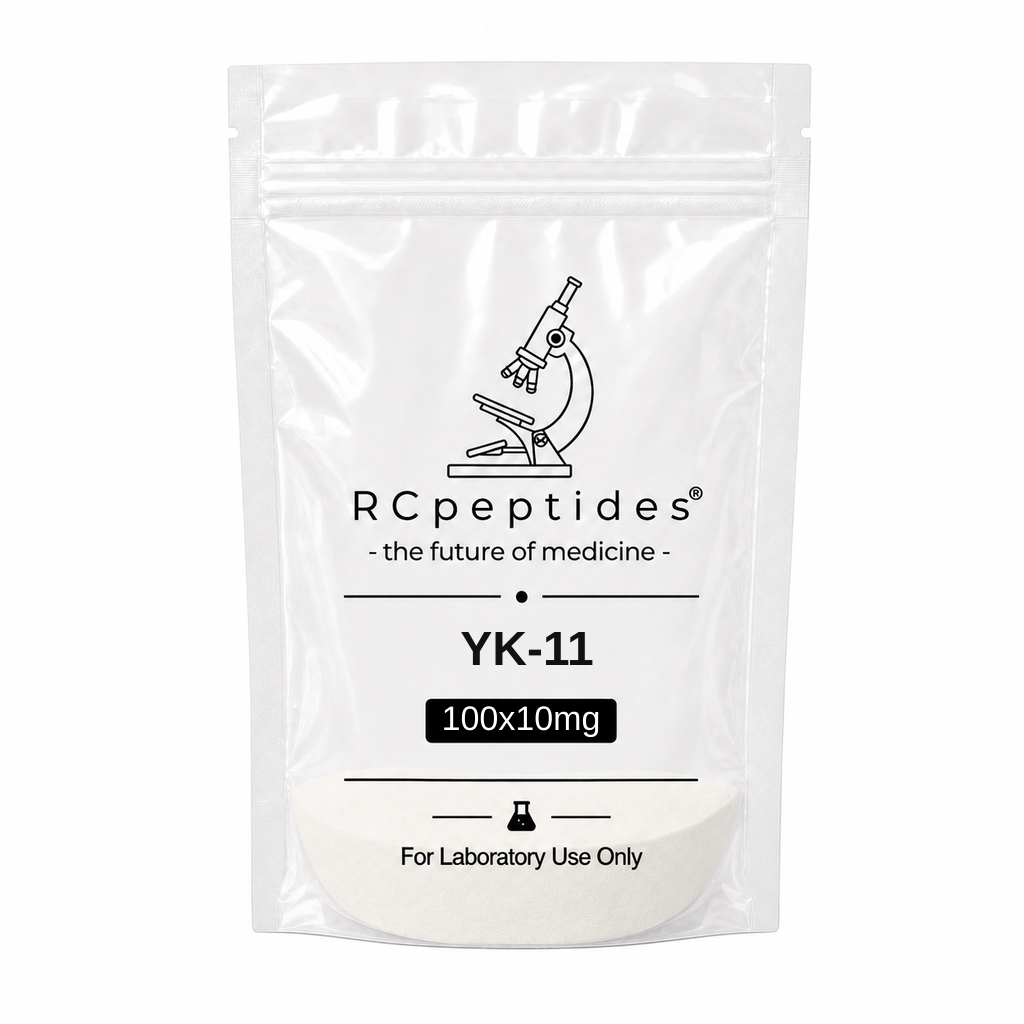
YK-11 100x10mg — YK-11 is a steroidal research compound characterized as a partial agonist of the androgen receptor. It has been studied in cell models of muscle differentiation. Its steroidal structure distinguishes it from the nonsteroidal compounds often grouped with it under the SARM label.
1. Compound and product overview
| Detail | Description |
|---|---|
| Compound | YK-11 (YK11) |
| Class / target | Steroidal androgen receptor partial agonist |
| Labelled presentation | YK-11 100x10mg |
| Research focus | Androgen receptor signalling and myogenic differentiation in cell models |
2. Mechanism and biological rationale
Androgen receptor activation can alter gene expression in responsive cells. Partial agonism describes the response in a specific system and comparison; it does not mean that a compound is free of androgenic or endocrine effects. Tissue selectivity and human safety cannot be inferred from that term alone.
A 2013 study in C2C12 mouse myoblasts examined follistatin expression and myogenic differentiation. The investigators found that an antibody against follistatin reversed the differentiation response associated with YK11. This supports a pathway hypothesis in that cell model, not proof that YK-11 directly neutralizes myostatin throughout the human body.
3. Benefits and effects studied
The table describes endpoints investigated in the cited research. The evidence level and study setting matter: findings for a study compound or pharmaceutical formulation do not establish the same outcomes for this catalogue material.
| Research area | Findings and evidence limits |
|---|---|
| Androgen receptor activity | The original pharmacology paper characterized YK11 as a partial androgen receptor agonist. This is receptor-level evidence and not a human clinical trial. |
| Myogenic differentiation | The C2C12 study reported differentiation-related responses under its experimental conditions. A change in cultured cells does not establish a quantified increase in human muscle size or strength. |
| Follistatin-related signalling | The observed relationship with follistatin supports mechanistic investigation. It should not be relabelled as proven systemic myostatin blockade or guaranteed prevention of muscle loss. |
| Evidence boundaries | The cited papers do not establish clinical bone-density benefits, liver protection, cardiovascular safety or a safe performance-enhancement regimen. |
4. Evidence in context
The core publications concern cell-based pharmacology. They do not justify precise human hypertrophy percentages or claims of negligible endocrine suppression. Effects measured with one cell line and comparison compound need independent validation in another setting.
The counted 100x10mg presentation and the 70mg/ml 10ml presentation describe different supplied formats. Those label details do not establish equivalent absorption or an interchangeable exposure schedule. Match the actual material and analytical specification to the experiment rather than transferring conclusions from a product name.
5. Product identity and laboratory considerations
Match the product name and labelled amount to the batch documentation before selecting a material for an experiment. Identity, purity and measured content answer different questions: a purity percentage alone does not establish the amount of the named compound, its biological activity, or the absence of every possible contaminant.
Use the original certificate where available to check the tested batch, analytical method and reported results. A result belongs to the sample and tests described in that report; it should not be extended to a different batch or treated as a clinical evaluation. Storage, solvent compatibility and stability after preparation require the documentation for the actual material and the conditions of the planned assay. A vial size is a product specification, not a treatment schedule.
6. Research scope
This listing supplies a research material. Published clinical studies use defined formulations, eligibility criteria, monitoring and analytical controls that are not established by this product listing. Laboratory observations, biomarkers and clinical outcomes should be interpreted separately. The cited literature provides background for scientific evaluation; it is not evidence that this particular product has been tested for therapeutic efficacy or safety.
Selected scientific references
- Kanno et al. — YK11 as an androgen receptor partial agonist (2011)
- Kanno et al. — YK11, follistatin and C2C12 differentiation (2013)
For in vitro laboratory research use only. Not for human or veterinary use. Not intended for diagnosis, treatment or prevention of disease.
Price: €85.00
Collection: SARMs
Batch test results and COAs
Research use only. Not for human consumption.